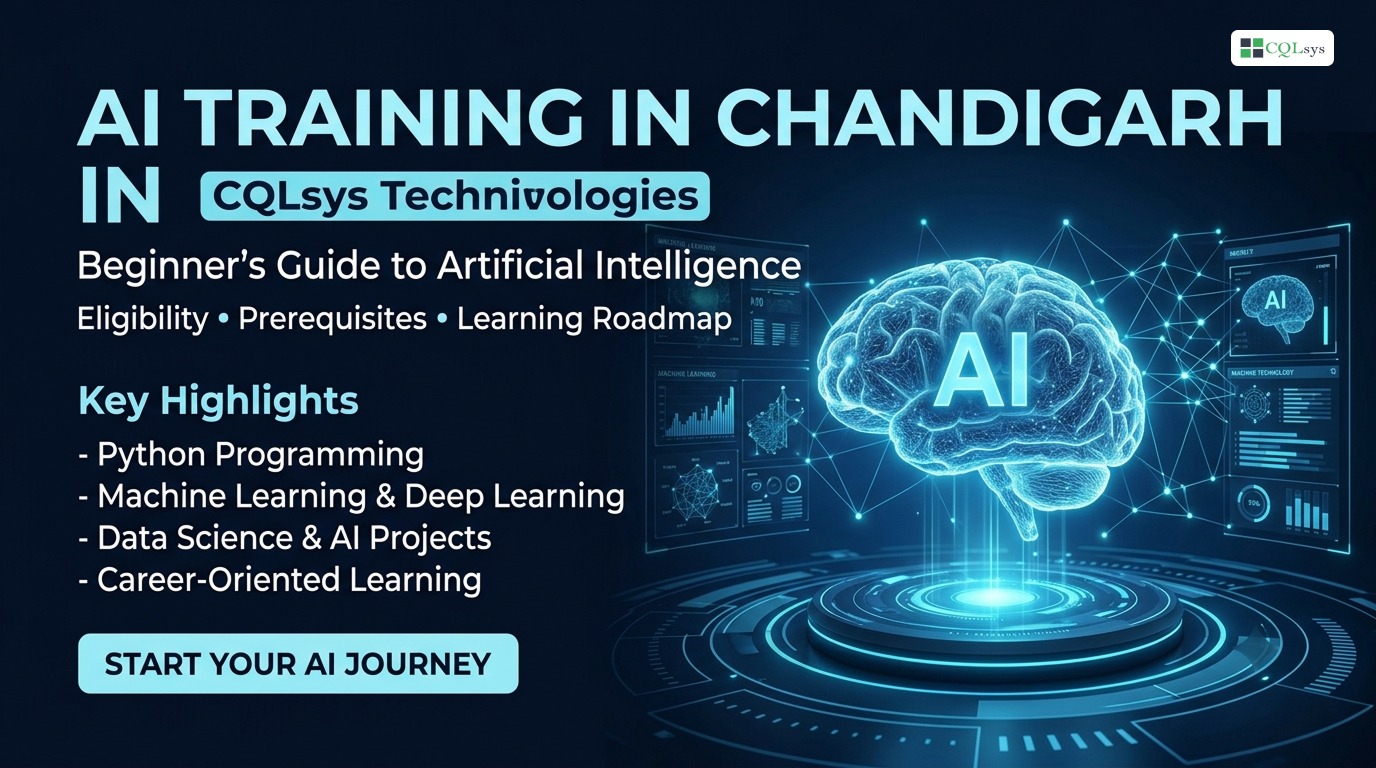
AI Training in Chandigarh for Beginners: Eligibility, Prerequisites & Learning Roadmap
Introduction
The rapid integration of artificial intelligence across global industries has transformed the technology landscape completely. Organizations across healthcare, finance, retail, and manufacturing demand skilled professionals who understand how to design, build, and deploy intelligent systems. For aspiring technologists and students in northern India, pursuing professional AI training in Chandigarh provides a definitive gateway into this high-growth domain. Entering the artificial intelligence ecosystem without a structured plan can feel overwhelming due to the sheer volume of concepts, tools, and frameworks. This article explores the eligibility criteria, fundamental prerequisites, core technical concepts, and a step-by-step learning roadmap designed specifically for beginners entering the artificial intelligence industry.
Understanding the Regional AI Landscape in Chandigarh
Chandigarh has evolved significantly into a dynamic technology and education hub. With numerous IT parks, software development firms, and growing digital enterprises establishing operations in the region, the demand for certified artificial intelligence and machine learning practitioners has surged. Professionals and students no longer need to relocate to metropolitan centers to acquire advanced technical skills. Local institutions and specialized technology firms offer robust training initiatives tailored to bridge the gap between academic theory and enterprise-level execution.
Acquiring practical skills through a structured AI course in Chandigarh enables learners to engage directly with real-world problem-solving methodologies, data preparation techniques, and model evaluation processes. This regional growth aligns with national initiatives promoting digital transformation and technology adoption across Indian enterprises.
Eligibility Criteria for Beginner AI Programs
Determining eligibility for an artificial intelligence training program depends largely on the depth of the curriculum and the target proficiency level. Beginner courses are designed to accommodate diverse academic and professional backgrounds.
- Academic Background: Candidates holding a bachelor degree in computer science, information technology, mathematics, statistics, engineering, or physics find foundational concepts intuitive. However, many beginner programs welcome graduates from non-technical disciplines provided they demonstrate analytical aptitude.
- Professional Freshers: Recent graduates looking to transition into software development, data analysis, or artificial intelligence roles can enroll directly in foundational tracks.
- Working Professionals: Software engineers, database administrators, and IT support specialists seeking career pivot opportunities utilize beginner programs to upskill without pausing their current professional commitments.
Essential Prerequisites Before Starting Your AI Journey
Before diving into complex neural networks and predictive modeling, learners must establish a solid foundation in specific prerequisite domains. Skipping these fundamentals often leads to challenges when implementing algorithms or interpreting model results.
Basic Mathematics & Statistics → Programming Fundamentals → Data Structures & Algorithms → Artificial Intelligence Core
Mathematical Foundations
Understanding artificial intelligence requires a working knowledge of linear algebra, calculus, and probability. Matrix multiplications, vector spaces, derivatives for optimization algorithms, and probability distributions form the mathematical backbone of machine learning models.
Programming Competency
Proficiency in at least one high-level programming language is essential. Python remains the undisputed standard in the artificial intelligence community due to its extensive ecosystem of libraries, readable syntax, and active developer community. Learners should familiarize themselves with basic syntax, control structures, functions, and object-oriented programming principles.
The Complete Learning Roadmap for Beginners
A successful transition into the artificial intelligence domain requires a structured, multi-phase progression. A well-designed curriculum moves from basic concepts to advanced application development.
| Phase | Focus Area | Key Learning Objectives |
|---|---|---|
| Phase 1 | Foundations & Programming | Python syntax, data structures, basic statistics, and SQL fundamentals. |
| Phase 2 | Data Engineering & Analysis | Data cleaning, exploratory data analysis, visualization libraries, and preprocessing. |
| Phase 3 | Core Machine Learning | Supervised and unsupervised learning, regression, classification, and model evaluation. |
| Phase 4 | Deep Learning & Specialization | Neural networks, computer vision, natural language processing, and generative models. |
| Phase 5 | Deployment & Projects | Model serialization, cloud integration, API creation, and portfolio development. |
Enrolling in a recognized AI course in Chandigarh ensures that learners receive structured guidance through each of these vital developmental milestones.
High-Level Solution Architecture for AI Learning Environments
Understanding how enterprise artificial intelligence systems operate helps learners connect theoretical algorithms with production-ready software architecture. A typical enterprise AI ecosystem integrates data ingestion pipelines with model training and inference layers.
Data Sources → Data Ingestion & Preprocessing → Feature Store → Model Training Engine → API Gateway → Client Application (Web/Mobile)
Data Ingestion & Preprocessing Layer
Raw enterprise data originates from multiple sources such as transactional databases, customer relationship management systems, and external APIs. This layer cleans, normalizes, and prepares data for consumption by machine learning algorithms.
Model Training & Inference Engine
This central processing unit trains predictive models using historical datasets and serves real-time predictions via secure application programming interfaces. High-performance computing clusters or cloud-based instances execute heavy computational tasks efficiently.
Technology Stack for Modern Artificial Intelligence Development
Selecting the right technology stack is crucial for building scalable and maintainable artificial intelligence solutions. Modern development relies on open-source libraries and robust cloud infrastructure.
- Programming Languages: Python, R, and JavaScript for web-based AI integration.
- Data Manipulation & Analysis: Pandas, NumPy, and SciPy.
- Machine Learning & Deep Learning Frameworks: Scikit-Learn, TensorFlow, PyTorch, and Keras.
- Cloud & Infrastructure: Amazon Web Services, Microsoft Azure, and Google Cloud Platform.
- Database & Storage: PostgreSQL, MongoDB, and Redis for caching model states.
For organizations and learners looking to explore comprehensive technology adoption, engaging with an established AI course in Chandigarh provides practical exposure to these industry-standard tools.
Real-World Use Cases of Artificial Intelligence
Artificial intelligence delivers measurable value across numerous industry verticals by automating repetitive tasks and generating actionable insights.
- Healthcare: Predictive diagnostic models assist clinicians in identifying early disease markers from medical imaging scans.
- FinTech: Automated fraud detection algorithms analyze transaction patterns in real time to flag suspicious activities instantly.
- Retail & E-commerce: Recommendation engines analyze user browsing behavior to deliver personalized product suggestions and optimize inventory levels.
- Logistics: Route optimization algorithms reduce fuel consumption and delivery times across enterprise supply chains.
Security, Privacy, and Ethical Considerations
Implementing artificial intelligence solutions within enterprise environments necessitates strict adherence to data security and ethical guidelines. Developers must prioritize privacy, model fairness, and transparency.
- Data Encryption: Protecting sensitive user data both in transit and at rest using advanced cryptographic protocols.
- Access Control: Implementing role-based access control to ensure that only authorized personnel modify model parameters or training datasets.
- Responsible AI: Mitigating algorithmic bias by utilizing diverse training datasets and maintaining audit trails for model decision-making processes.
Why Choose CQLsys Technologies?
Navigating the complexities of artificial intelligence adoption requires partnering with experienced technology leaders. CQLsys Technologies delivers enterprise-grade solutions and professional mentorship tailored to modern business requirements. Organizations and learners seeking expert guidance benefit from proven delivery methodologies, dedicated engineering teams, and deep technical expertise across custom software development, cloud integration, and artificial intelligence solutions.
To accelerate your technological transformation, explore our specialized services in artificial intelligence development or review our complete portfolio of software development capabilities.
10 SEO FAQs
1. What are the basic eligibility requirements for AI training?
Basic eligibility for beginner artificial intelligence training programs typically includes a foundational understanding of mathematics, analytical problem-solving skills, and basic computer literacy. While a degree in computer science or engineering is advantageous, enthusiastic learners from non-technical backgrounds can succeed by mastering programming prerequisites first. Enrolling in a structured AI course in Chandigarh helps bridge any academic gaps effectively.
2. Do I need prior coding experience to join an AI course?
Prior coding experience is helpful but not strictly mandatory for beginner-friendly programs. Most comprehensive training tracks start with fundamental programming concepts using Python before moving into advanced machine learning algorithms. Beginners are encouraged to practice basic coding exercises consistently to build confidence and ensure a smooth learning progression.
3. How long does it take to learn artificial intelligence from scratch?
Learning artificial intelligence from scratch typically takes between six to twelve months of dedicated study and practical project work. The exact timeline depends on the learner's prior technical background, daily time commitment, and the depth of the curriculum. Consistent hands-on coding practice significantly accelerates overall skill acquisition and portfolio readiness.
4. What career opportunities are available after AI training in Chandigarh?
Completing professional artificial intelligence training opens doors to diverse career paths such as Junior Machine Learning Engineer, Data Analyst, AI Software Developer, and Business Intelligence Specialist. The growing technology ecosystem in northern India offers numerous entry-level positions across startups, IT services firms, and multinational enterprises seeking certified talent.
5. Is mathematics mandatory for learning machine learning?
A foundational understanding of mathematics, particularly linear algebra, calculus, and probability, is essential for grasping how machine learning algorithms function beneath the surface. While developers can use pre-built libraries without deriving every formula, strong mathematical knowledge empowers practitioners to optimize model performance and troubleshoot complex issues effectively.
6. Which programming languages are taught in beginner AI courses?
Python is the primary programming language taught in almost all modern artificial intelligence and machine learning courses. Its clear syntax, extensive library ecosystem, and widespread enterprise adoption make it the undisputed industry standard for data science, neural network design, and artificial intelligence application development.
7. Can working professionals enroll in part-time AI training programs?
Many training providers offer flexible schedules, weekend batches, and online modules specifically designed for working professionals seeking career advancement without disrupting their current employment. Balancing practical assignments with daily professional duties allows engineers to upskill efficiently and apply new knowledge directly to workplace projects.
8. What is the role of practical projects in artificial intelligence learning?
Practical projects are critical for transforming theoretical knowledge into demonstrable workplace competence. Building real-world applications, such as predictive models or natural language processing tools, helps learners understand data preprocessing, model tuning, and deployment challenges that cannot be learned from textbooks alone.
9. How does CQLsys Technologies support aspiring AI professionals?
CQLsys Technologies provides comprehensive technical guidance, enterprise consulting, and specialized training frameworks designed to equip learners with industry-ready skills. By focusing on practical implementation and modern technology stacks, professionals gain the confidence needed to tackle complex enterprise challenges successfully.
10. How can I enroll in a professional AI training program?
Enrolling in a professional training program begins with assessing your current skill level, reviewing curriculum details, and scheduling an initial consultation with industry experts. To discuss your learning goals and discover custom training roadmaps, visit our contact us page to connect with our team directly.
Strategic CTA
Ready to accelerate your career or transform your enterprise capabilities with advanced artificial intelligence solutions? Partner with industry experts who combine technical excellence with practical business strategy. Connect with our team today through our contact page to discuss your custom training requirements or software development project.
Connect with CQLsys Technologies:
- LinkedIn: https://www.linkedin.com/company/cqlsys-technologies
- Facebook: https://www.facebook.com/cqlsys
- Instagram: https://www.instagram.com/cqlsys