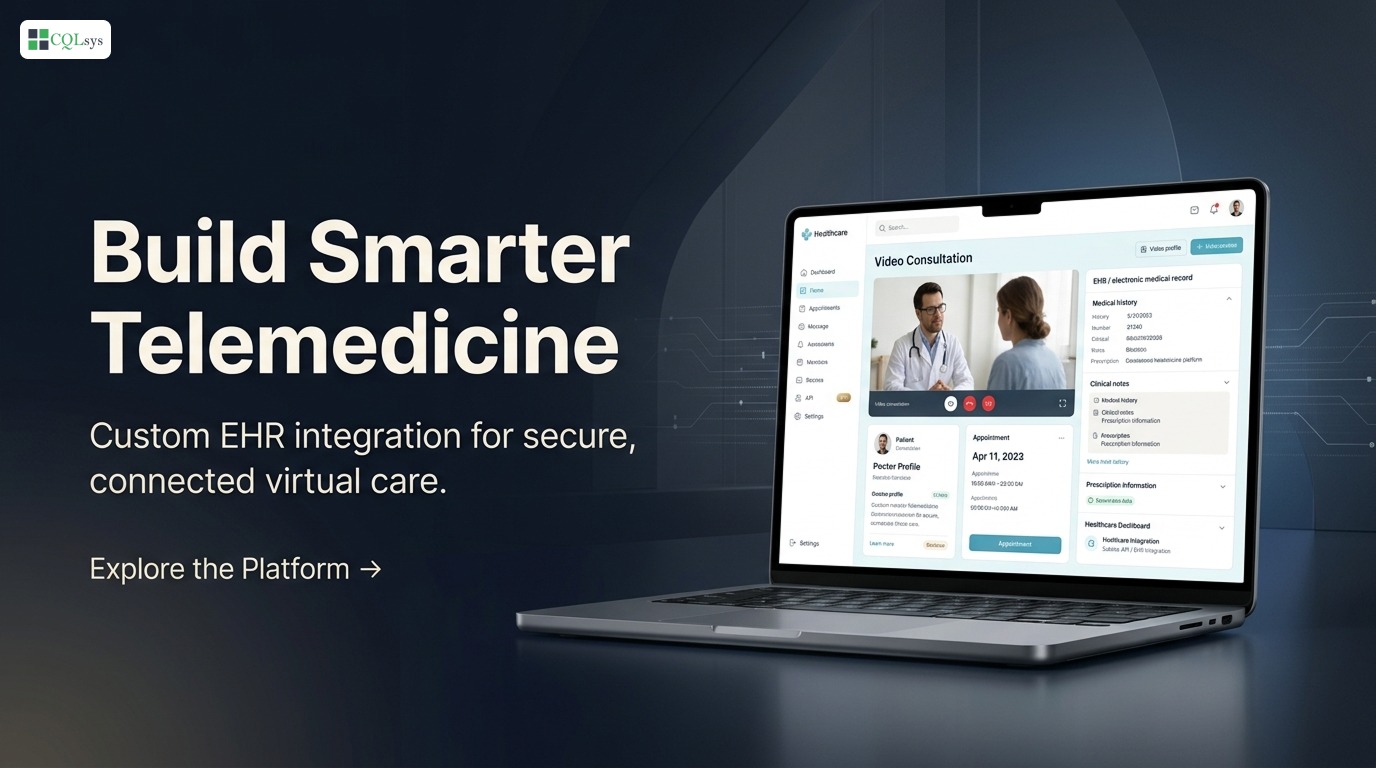
How to Build a Custom EHR-Integrated Telemedicine Platform
Modern healthcare delivery demands frictionless digital access without sacrificing clinical continuity. Off-the-shelf virtual care applications frequently fail enterprise health systems because they operate as isolated data islands, forcing clinicians to double-document patient encounters and navigate fragmented workflows. Building a custom EHR-integrated telemedicine platform solves this disconnect by embedding real-time video, remote patient monitoring, and asynchronous messaging directly into existing Electronic Health Record ecosystems.
Healthcare founders, Chief Information Officers, and HealthTech product leaders must navigate technical complexities ranging from real-time media transport to strict regulatory compliance when engineering these solutions. Achieving bidirectional synchronization with major systems like Epic and Cerner requires a disciplined engineering approach centered on modern health data standards, robust API design, and end-to-end encryption. This comprehensive guide outlines the operational considerations, system architecture, security frameworks, and implementation roadmaps necessary to deploy an enterprise-grade telehealth platform.
Executive Summary: The Business Case for Custom Integration
Commercial off-the-shelf telehealth products offer fast deployment times, but their static features quickly create operational bottlenecks for scaling healthcare organizations. Custom engineering ensures that virtual encounters mirror exact clinical pathways, billing rules, and provider schedules.
- Elimination of Administrative Overhead: Automatic sync of consultation notes, vital signs, and diagnostic billing codes into the primary EHR reduces manual charting time for physicians.
- Unified Patient Experience: Patients access scheduling, video rooms, payment processing, and medical records through a single branded portal rather than navigating multiple disparate tools.
- Data Integrity and Governance: Bidirectional pipelines ensure patient metrics, clinical histories, and treatment plans remain synchronized across inpatient and ambulatory settings without data duplication.
- Long-Term Scalability: A modular architecture allows healthcare systems to introduce proprietary artificial intelligence triage tools, custom device integrations, and specialized care management workflows over time.
Technical Foundations: Standards and Real-Time Protocols
Architecting a high-performance EHR-integrated telemedicine platform development strategy relies on two foundational technology pillars: standardized health data exchange frameworks and low-latency real-time communications protocols.
Health Data Interoperability Standards
To communicate with legacy infrastructure and modern cloud clinical platforms, custom systems must implement standardized protocol handlers:
- Fast Healthcare Interoperability Resources (FHIR): Built on modern RESTful web standards, FHIR uses JSON-based resources (such as Patient, Appointment, Observation, and DocumentReference) to provide granular, near-real-time access to patient data.
- Health Level 7 Version 2 (HL7 v2): While older, HL7 v2 messaging (such as ADT for admission/discharge/transfer and SIU for scheduling) remains heavily utilized in legacy hospital infrastructures. Custom integrations must maintain backward compatibility using interface engines.
- SMART on FHIR: An open-standard authorization layer that allows third-party web and mobile applications to run securely inside EHR interfaces without exposing root database credentials.
Real-Time Media Communication Pipeline
Video consultation quality directly impacts diagnostic precision and
clinical outcomes. Utilizing
WebRTC video streaming healthcare protocols provides peer-to-peer,
low-latency audio-video
sessions directly within browser and mobile environments without
requiring third-party plugins.
WebRTC uses Secure Real-Time Transport Protocol (SRTP) for media
stream encryption and
Interactive Connectivity Establishment (ICE) alongside STUN/TURN
servers to traverse restrictive
hospital firewalls and NAT networks reliably.
High-Level Solution Architecture
A scalable enterprise telehealth platform requires a clear separation of concerns across multiple application tiers. This modular structure ensures data security, system elasticity, and maintenance isolated from third-party vendor downtime.
System Architecture Flow
Users (Patients & Physicians) → Client Layer (Web/Mobile Apps) → Security & Edge Layer (WAF, CDN, API Gateway) → Core Application Layer (Scheduling, Video Orchestration, Workflows) → Integration & Messaging Layer (FHIR Server, HL7 Engine) → Core Data Layer (Encrypted Storage, Analytics) → External Systems (Epic, Cerner, Payment Gateways)
Architectural Components Breakdown
User & Client Experience Layer
Comprises responsive web portals and native iOS/Android mobile applications. Patients use this layer for appointment bookings, pre-visit intake forms, virtual waiting rooms, and video calls. Clinicians access an integrated interface or launch the application contextually within their native EHR workspace using SMART on FHIR frames.
Security & Edge Gateway
Sits in front of internal microservices to manage traffic distribution, enforce SSL/TLS termination, and defend against malicious attacks. The Web Application Firewall inspects incoming payloads, while an API Gateway manages rate limits, validates OAuth 2.0 bearer tokens, and routes requests to appropriate downstream services.
Core Application Layer
Contains business logic microservices handling domain tasks:
- Session Orchestrator: Manages WebRTC signaling, channel token issuance, and virtual waiting room states.
- Workflow Engine: Automates intake surveys, prescription routing, follow-up scheduling, and billing code generation.
- Notification Service: Dispatches real-time alerts via SMS, email, or push notifications using secure gateway integrations.
Integration & Data Pipeline Layer
Serves as the translator between the custom platform and institutional clinical databases:
- FHIR Facade Server: Translates internal application requests into standardized FHIR RESTful resources.
- HL7 Interface Engine: Listens to socket connections for real-time ADT and scheduling events from core hospital systems.
- Bidirectional Sync Queue: Manages asynchronous data pipelines using message queues to prevent database lockups during peak usage hours.
Secure Data Layer
Houses persistent transactional databases, media storage for session recordings (if permitted and consent-backed), and transient memory caches. High-performance databases handle relational metadata like user profiles and appointment schedules, while encrypted object storage secures uploaded diagnostic images and clinical PDF exports.
Architecture Component Mapping
The implementation of each layer requires enterprise technology selections configured to handle high throughput and stringent compliance requirements.
| Architecture Component | Primary Purpose | Suitable Enterprise Technology |
|---|---|---|
| Frontend Clients | Cross-platform web and mobile user interfaces | React, Next.js, React Native, Flutter |
| Backend Services | Core business logic and microservice execution | Node.js, Python (FastAPI), Go, .NET Core |
| Integration Layer | HL7 v2 / FHIR message routing and transformation | HAPI FHIR Server, Mirth Connect (NextGen Connect) |
| Real-Time Streaming | Low-latency WebRTC media session control | LiveKit, Twilio Programmable Video, AWS Chime SDK |
| Primary Database | Encrypted relational and document state storage | PostgreSQL (TDE enabled), MongoDB Enterprise |
| Caching & Queues | In-memory session tracking and async processing | Redis Enterprise, Apache Kafka |
| Cloud Infrastructure | Scalable, compliant hosting environments | AWS (HIPAA Eligible Services), Azure Health Data Services |
Feature Matrix: Basic vs. Custom EHR-Integrated Solutions
Deploying a custom platform allows organizations to go beyond standard off-the-shelf software, delivering deep functional parity between physical and virtual care settings.
| Feature Area | Basic Off-the-Shelf Solution | Custom EHR-Integrated Platform |
|---|---|---|
| Data Synchronization | Manual CSV export or static batch PDF uploading | Real-time bidirectional HL7 FHIR sync of vitals, notes, and lab requests |
| Provider Workflow | Separate tab/login required; manual double-entry | Single Sign-On launch directly within Epic or Cerner interface |
| Patient Onboarding | Generic pre-call questionnaire | Custom clinical intake tailored dynamically to medical history pulled from EHR |
| Media Quality | Variable third-party cloud routing | Custom WebRTC infrastructure with dynamic bandwidth adaptation and media relay |
| Compliance & Logs | Basic event logging | Comprehensive audit trails with SIEM integration and granular access controls |
| Brand Customization | Vendor branding with minor logo customization | 100% white-labeled digital footprint across web, mobile, and communication channels |
Security, Privacy, and Compliance Controls
Building a HIPAA compliant telemedicine platform requires rigorous risk mitigation strategies at all infrastructure layers. Beyond standard federal privacy mandates, global health organizations must satisfy rigorous standards like GDPR, SOC 2 Type II, and HITRUST CSF.
Administrative and Physical Safeguards
Access to production infrastructure must adhere to the Principle of Least Privilege. Administrative access requires multi-factor authentication, hardware security keys, and isolated VPN/Bastion host entry points. Hardware systems housing patient data must reside in SOC 2-certified cloud data centers offering physical access logging and automated off-site backups.
Technical Security Controls
Data Encryption Standard
All Protected Health Information (PHI) in transit must utilize TLS 1.3 encryption protocols. Data at rest across persistent databases, backup storage drives, and server caches must be protected using Advanced Encryption Standard (AES) with 256-bit keys.
Identity & Access Management (IAM)
Implement OAuth 2.0 paired with OpenID Connect (OIDC) for user authentication. Role-Based Access Control (RBAC) ensures that patients, general practitioners, specialists, and administrative staff access only the minimal necessary dataset needed for their specific domain duties.
Immutable Audit Logging
To meet federal compliance mandates, systems must maintain tamper-evident, append-only logs for every access request, data read, update, or deletion involving PHI. Logs should automatically stream to a centralized Security Information and Event Management (SIEM) tool for continuous anomaly detection.
Comprehensive Implementation Roadmap
Building an enterprise-grade virtual care engine requires a structured execution framework divided into phased milestones.
Phase 1: Clinical Workflow & Compliance Discovery
Define precise clinical requirements, target EHR interfaces (such as Epic MyChart or Cerner PowerChart), and state or national compliance rules. Map all data flows, identifying mandatory fields required for billing, prescriptions, and charting.
Phase 2: Architecture & Integration Specification
Construct detailed system topology blueprints and data transformation maps. Establish test environments for HL7/FHIR message validation, provision secure sandbox environments with EHR vendor developer programs, and finalize API specifications.
Phase 3: Core Application & Pipeline Development
Build core software components, starting with the identity management framework, user application shells, and WebRTC media servers. Simultaneously engineer the FHIR facade and interface engines, ensuring data transformations accurately map internal application states to clinical resources.
Phase 4: EHR Interface & Sandbox Testing
Connect the custom application to vendor sandbox systems (such as Epic USCDI FHIR endpoints or Cerner Millennium sandbox). Perform end-to-end testing covering patient search, appointment creation, media streaming, and document write-backs.
Phase 5: Security Auditing & Compliance Verification
Perform penetration testing, vulnerability scans, and static/dynamic code analysis. Execute a comprehensive Security Risk Assessment (SRA) and establish signed Business Associate Agreements (BAAs) with all cloud infrastructure providers and third-party API vendors.
Phase 6: Pilot Deployment & Clinical Rollout
Launch a controlled pilot involving a small subset of clinical staff and patient cohorts. Monitor system metrics including WebRTC call drop rates, FHIR pipeline latency, and user feedback. Gradually scale system resources as onboarding expands across hospital departments.
Cost Factors and ROI Drivers
The capital expenditure involved in building a custom virtual care system varies based on workflow complexity, the number of integration targets, and performance demands.
Key Development Cost Drivers
- Integration Complexity: Interfacing with legacy HL7 v2 networks alongside modern FHIR APIs increases engineering time compared to building standalone applications.
- Media Infrastructure: Deploying custom STUN/TURN media relay servers for WebRTC calls demands careful capacity planning and geographically distributed edge infrastructure.
- Regulatory Rigor: Implementing comprehensive audit controls, continuous logging infrastructure, and security validation routines requires specialized compliance engineering.
- Custom Clinical Tools: Incorporating complex clinical tools—such as real-time remote device telemetry (Bluetooth pulse oximeters, digital stethoscopes) or custom scheduling matrices—adds overall scope.
ROI and Long-Term Value Creation
While initial capital expenditure is higher than off-the-shelf subscriptions, custom platforms yield distinct financial and operational dividends over time:
- Lower Variable Operating Costs: Eliminates perpetual per-provider monthly licensing fees that accumulate rapidly as health networks expand.
- Increased Provider Productivity: Streamlined, single-interface workflows allow providers to complete charting during visits, increasing daily patient capacity and lowering burnout rates.
- Reduced Claims Denials: Automatic ingestion of validated diagnostic codes directly from virtual intake fields into the EHR billing queue minimizes billing errors and claim rejections.
- Higher Patient Retention: Superior, unified user experiences protect patient acquisition channels against market churn.
Organizations evaluating these technical options can review custom software development services to understand how tailored engineering creates lasting operational value.
Why Choose CQLsys Technologies?
Building a high-throughput, secure, and fully synchronized telehealth solution requires an engineering partner that understands both modern cloud native architectures and legacy healthcare technical environments.
CQLsys Technologies provides comprehensive engineering capabilities tailored to the HealthTech sector. Our specialized teams assist healthcare enterprises in navigating complex digital transformations from initial discovery through enterprise deployment.
- Healthcare Interoperability Mastery: Deep technical experience constructing robust HL7 v2, HL7 v3, and HL7 FHIR pipelines that sync seamlessly with leading EHR platforms like Epic, Cerner, and Allscripts.
- Secure Software Engineering: Security-first software development life cycles ensuring all client code, database structures, and server deployments strictly align with HIPAA and HITRUST security framework guidelines.
- Scalable Web & Mobile Solutions: Engineering experience in cross-platform real-time communications via customized mobile app development services and responsive web development solutions.
- Dedicated Advisory Teams: Strategic technology consultants working directly with health network CIOs and product teams to translate clinical goals into resilient, modular technology stack architectures.
Learn more about our full capabilities by exploring our overview or reading technological insights on our software engineering blog.
Frequently Asked Questions
How to ensure HIPAA compliance in EHR integration?
HIPAA compliance requires administrative, physical, and technical safeguards across the application architecture. Technical measures include end-to-end encryption for data in transit (TLS 1.3) and data at rest (AES-256), granular Role-Based Access Control, automated timeout mechanisms, multi-factor authentication, and append-only audit logging for PHI access. Additionally, healthcare entities must execute Business Associate Agreements with all cloud infrastructure and API vendors hosting or processing patient records.
What is the cost to build a custom EHR-integrated telemedicine platform?
Custom development costs vary widely based on scope, technical complexity, and regulatory requirements. Key cost factors include the number of EHR interfaces targeted, whether custom WebRTC media infrastructure is required, the level of workflow customization, and security engineering needs. While capital costs exceed standard off-the-shelf software subscriptions, custom solutions eliminate recurring per-provider license fees and yield higher ROI through automated clinical workflows.
How does HL7 FHIR facilitate telemedicine EHR sync?
HL7 FHIR uses modern web API standards, such as RESTful interactions using JSON or XML payloads, to expose distinct clinical datasets as granular "Resources" (e.g., Patient, Encounter, Observation). This allows a custom telemedicine application to read and write specific patient data points instantly via standard HTTP requests without parsing complex, legacy block messages, streamlining bidirectional clinical synchronization.
Can custom telemedicine platforms integrate with Epic and Cerner simultaneously?
Yes. By deploying an abstract integration layer—such as a FHIR facade server or integration engine—the platform converts internal application payloads into standardized FHIR resources. Since both Epic and Cerner support SMART on FHIR and standard USCDI FHIR profiles, a properly architected platform can interact with both systems simultaneously using uniform API endpoints.
What streaming technology is best for clinical video consultations?
WebRTC is the standard technology for browser- and mobile-based clinical video consultations. It supports low-latency, real-time peer-to-peer media delivery directly inside web browsers and native apps without requiring third-party plugins. Combined with Secure Real-time Transport Protocol (SRTP) encryption and custom STUN/TURN signaling relays, WebRTC delivers stable, secure video streams across varied network environments.
How long does custom EHR telemedicine integration take?
A full enterprise implementation lifecycle typically ranges from 4 to 9 months depending on integration scope. Initial discovery, architectural design, and core feature development usually consume the first 2 to 4 months. Interface connection, EHR sandbox testing, security auditing, and compliance verification take an additional 2 to 3 months before a phased pilot rollout can safely begin.
What are the core data security protocols for telehealth video calls?
Telehealth video media streams rely on Secure Real-Time Transport Protocol (SRTP) for media payload encryption, alongside Datagram Transport Layer Security (DTLS) for secure key exchange. Control signaling messages between the client application and media server are routed over encrypted HTTPS or Secure WebSockets (WSS) layers to prevent interception or session hijacking.
Why choose a custom telemedicine solution over off-the-shelf software?
Off-the-shelf software often operates as an isolated application, forcing clinicians to double-document encounter notes and navigate non-standard workflows. A custom platform integrates directly into existing clinical software, automates data synchronization, delivers a fully branded user experience, provides complete ownership over system data, and eliminates long-term vendor license costs per clinician.
How to handle bidirectional data sync between telemedicine app and EHR?
Bidirectional synchronization relies on an event-driven architecture using message queues and RESTful FHIR endpoints. When an event occurs in the telehealth app (e.g., a completed intake form or vitals capture), payload messages enter a secure queue that pushes data to the EHR via API write-backs. Conversely, EHR webhooks or HL7 listener sockets capture record changes in real time, updating the virtual platform.
What role does OAuth 2.0 play in patient data security?
OAuth 2.0 serves as the industry-standard protocol for authorization. It allows patients and providers to grant the telemedicine application access to their EHR records securely using scoped access tokens, without ever exposing user login credentials to third-party applications. This ensures that every API request operates within strictly defined security and identity boundaries.
Request a HIPAA-Compliant Architecture Consultation
Transitioning from fragmented virtual care tools to a synchronized clinical ecosystem demands experienced technical leadership. Contact our team of solution architects today to review your existing EHR infrastructure, evaluate integration goals, and design a scalable, secure, and fully compliant telehealth platform.
Request a HIPAA-Compliant Architecture Consultation
Connect with our engineering experts on social media: