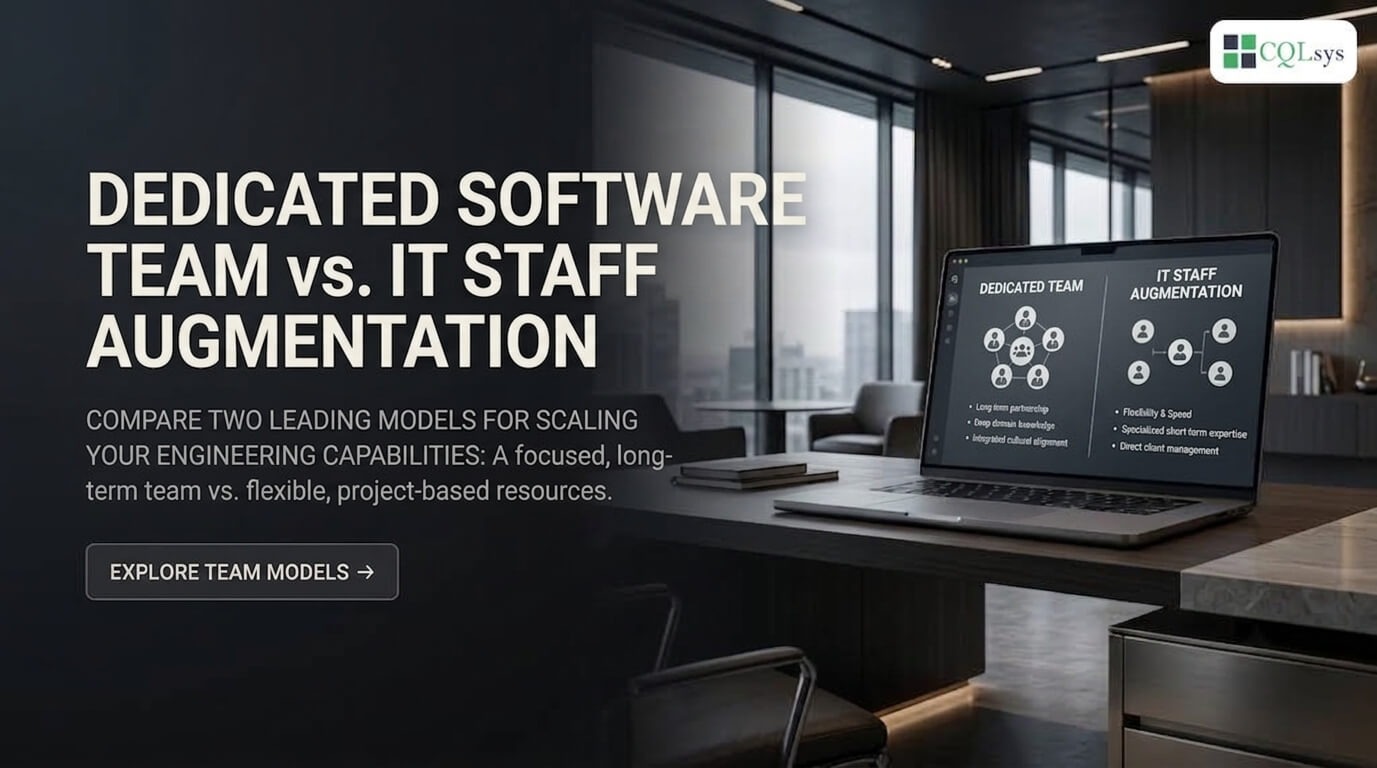
Dedicated Software Team vs. IT Staff Augmentation: CTO Procurement Guide
Modern engineering leadership requires balancing speed of delivery, budget optimization, architectural integrity, and team scalability. Chief Technology Officers, Vice Presidents of Human Resources, and IT Procurement Directors face a recurring strategic question: how to expand technical capacity effectively when internal hiring cannot keep pace with product roadmaps. Choosing between a dedicated team vs staff augmentation model shapes your organization's delivery velocity, technical debt, overhead, and intellectual property control.
Engineering procurement requires evaluating trade-offs across engagement structures. IT staff augmentation fills skill gaps directly within your existing management hierarchy. A dedicated software engineering team provides an autonomous, fully managed unit that delivers complete business outcomes. Selecting the optimal model requires analyzing operational oversight capacity, long-term product vision, financial structures, and team culture integration.
Strategic Overview of Engineering Procurement Models
When evaluating how to scale your engineering capacity, the two predominant approaches address entirely different organizational priorities.
- IT Staff Augmentation is designed for direct tactical control. It acts as an extension of your existing team to fill specific skill gaps, placing the management burden on your internal team through time and materials pricing.
- Dedicated Software Teams focus on strategic outcome delivery. The provider supplies an end-to-end managed team with embedded delivery governance, operating under predictable retainer or fixed-velocity pricing models.
Core Structural Differences: Dedicated Team vs Staff Augmentation
Evaluating dedicated team vs staff augmentation frameworks requires looking beyond simple staffing headcounts. The fundamental distinction lies in management ownership, delivery responsibility, and organizational integration.
Operational Workflows
In a Staff Augmentation Workflow, communication flows directly from your internal CTO or Project Manager to individual augmented developers who work directly within your internal codebase. Daily management, code reviews, and task prioritization remain strictly within your organization.
In a Dedicated Team Workflow, high-level strategic objectives and milestone goals move from your CTO or Director to the vendor's Delivery Manager. That Delivery Manager coordinates a fully equipped agile team—including developers, QA engineers, and DevOps specialists—to deliver the final product outcomes directly to your organization.
IT Staff Augmentation
Staff augmentation extends your existing internal engineering team using external developers, Quality Assurance engineers, or DevOps specialists. The vendor supplies individual technical professionals, but your internal engineering managers maintain daily operational oversight, sprint planning, task assignments, and technical direction. These developers integrate directly into your internal workflows, communication channels, and agile cadences.
- Management Control: Internal technical managers directly assign daily work, review code, and manage capacity.
- Delivery Accountability: Your organization retains full responsibility for product delivery outcomes, velocity, and technical architecture.
- Integration Level: External talent functions as embedded team members alongside your full-time staff.
Dedicated Software Engineering Team
A dedicated software team delivers an autonomous engineering unit structured specifically for your product roadmap. The team includes specialized software developers, QA engineers, automated test experts, UI/UX designers, DevOps specialists, and a dedicated Scrum Master or Delivery Manager. The vendor manages day-to-day agile processes, resource allocation, and quality checks while working toward performance metrics and project goals defined with your leadership team.
- Management Control: The vendor's Delivery Manager manages daily assignments, sprint execution, and operational blockers.
- Delivery Accountability: Shared accountability governed by clear Key Performance Indicators, milestone deliverables, and Service Level Agreements.
- Integration Level: Operates as an aligned extension of your engineering organization, integrating at the architectural, roadmap, and executive governance levels.
When to Choose IT Staff Augmentation
IT staff augmentation services offer flexibility when your technical leadership requires precise capacity expansion to execute defined development plans.
Decision Path for Staffing Needs
To determine if staff augmentation is the right path, evaluate your current technical bottleneck. If your primary challenge is a specific technical skill gap within an existing project, staff augmentation allows you to add targeted expertise quickly under short-to-medium term agreements managed by internal leadership.
However, if your challenge involves building a complete, standalone product or module from scratch, a dedicated team provides the necessary end-to-end delivery management, long-term alignment, and vendor-backed KPI ownership.
Strategic Triggers for Staff Augmentation
- Immediate Skill-Gap Filling: You need specialized expertise for immediate implementation—such as a cloud security architect to audit AWS infrastructure, or a specialized Flutter engineer for a cross-platform mobile release.
- Absorbing Temporary Capacity Spikes: Your internal roadmap demands rapid scaling to meet a firm release deadline, after which core staffing levels will return to baseline.
- Strong Internal Engineering Management: Your engineering team has established, scalable agile processes, robust code review systems, and sufficient management bandwidth to oversee additional individual engineers.
- Maintaining Architectural Control: Your enterprise needs absolute, granular daily control over code development, commit histories, and system architecture design.
Staff Augmentation Model Profile
- Ramp-Up Speed: Fast (1 to 2 weeks for individual specialists).
- Management Effort: High (Internal managers oversee daily tasks and pull requests).
- Cost Structure: Hourly rate or Time & Materials billing.
- Technical Debt Risk: Medium (Requires strict internal code review and standards enforcement).
- Ideal Project Type: Feature additions, cloud migrations, framework updates, and rapid team scaling.
When to Deploy a Dedicated Software Team
Deploying a dedicated software development team works best for long-term product development, core system overhauls, or building new digital platforms when internal management capacity is limited.
Dedicated Team Model Profile
- Ramp-Up Speed: Moderate (2 to 4 weeks to align team dynamics, architecture, and context).
- Management Effort: Low to Medium (Vendor Delivery Manager manages internal team execution).
- Cost Structure: Monthly team retainer or velocity-based sprint pricing.
- Technical Debt Risk: Low (Vendor enforces architecture best practices and automated QA).
- Ideal Project Type: Greenfield MVP creation, enterprise platform overhauls, and complex product builds.
Strategic Triggers for a Dedicated Team
- New Product Development & Platform Rebuilds: You are launching a greenfield application, migrating a legacy enterprise platform, or building a standalone SaaS product requiring end-to-end engineering focus.
- Limited Internal Management Bandwidth: Your CTO, Engineering Directors, and Product Managers are fully focused on core platforms and cannot take on daily management of additional engineering resources.
- Long-Term Engineering Capacity: You require sustained engineering velocity for 12+ months and need a team that learns your domain deeply, building institutional product knowledge over time.
- Complete Skill Integration: You need a cross-functional team including UI/UX design, frontend and backend development, automated QA testing, and CI/CD pipeline management operating together from day one.
Operational Oversight and Management Requirements
Managing remote developer procurement requires understanding how management overhead impacts overall team cost and delivery speed.
Management Overhead Dynamics
Under Staff Augmentation, internal executives and managers absorb a significant operational load. Your CTO, Engineering Managers, and Product Leads must directly manage both in-house developers and external augmented staff. This includes conducting daily standups, making individual task assignments, executing code reviews, and handling onboarding. High internal management ratios can slow down overall release velocity if leadership becomes bottlenecked.
Under a Dedicated Team, your leadership maintains high-level product and architectural alignment while handing daily operational execution over to the vendor's Delivery Manager. That Delivery Manager oversees dedicated tech leads, QA leads, software engineers, and automation specialists. Internal management overhead remains low, limiting leadership involvement to milestone reviews, roadmap adjustments, and high-level KPI tracking.
Operational Load Under Staff Augmentation
Staff augmentation requires high internal management involvement. Your internal engineering managers handle:
- Daily sprint planning, backlog grooming, and task allocation.
- Code reviews, pull request approvals, and enforcing coding standards.
- Resolving technical blockers, managing performance, and supporting professional development.
- Onboarding resources into internal tools, repositories, and communication workflows.
Operational Governance Under a Dedicated Team
Dedicated teams use a structured governance framework that minimizes daily management requirements for your leadership:
- Executive Steering Committee: Monthly or quarterly reviews between client leadership (CTO/VP) and vendor delivery executives to assess roadmap progress, budget, and high-level milestones.
- Delivery Management: The vendor's Delivery Manager handles daily agile rituals, task tracking, sprint reviews, and team performance management.
- Clear KPI Tracking: Performance is measured through delivery velocity, sprint completion rates, defect densities, and system uptime rather than individual hourly output.
Total Cost of Ownership Comparison
Direct hourly rates do not reflect the full cost of external engineering teams. A realistic financial assessment requires calculating the Total Cost of Ownership (TCO), including internal management overhead, onboarding expenses, operational tools, and potential technical debt.
Breakdown of Cost Factors
- Direct Talent Costs: Staff augmentation relies on hourly rates, while dedicated teams use predictable monthly team billing.
- Internal Management Overhead: Staff augmentation incurs high internal cost (15–25% of managerial time), whereas dedicated teams keep this low (5–10%).
- Tooling & Licensing: Tooling costs are typically covered by the client in staff augmentation, while dedicated teams often bundle core tools and infrastructure management.
- Onboarding & Ramp-Up Expenses: Client teams absorb onboarding costs for augmented staff, whereas dedicated teams utilize shared or vendor-led onboarding frameworks.
- Knowledge Retention Risk: Staff augmentation carries higher long-term knowledge loss risks when contractors offboard, whereas dedicated teams retain deep domain context across long engagements.
- Quality Assurance & Testing: Staff augmentation requires separate internal QA management, while dedicated teams provide fully integrated testing protocols.
Cost Factor Details
1. Management Overhead Expenses
Staff
augmentation requires significant time from internal engineering
managers, product leads, and architects. If a senior manager earning
$180,000 annually spends 25% of their time managing external staff,
that adds $45,000 per year in internal overhead. Dedicated teams
include vendor delivery management within the contract structure,
reducing internal overhead.
2. Ramp-Up Efficiency and Domain
Retention
Augmented developers work on specific,
assigned tasks. When contract periods end, their domain knowledge
leaves with them. If those skills are needed again later, onboarding
costs repeat. A dedicated team retains institutional domain
knowledge across project phases, standardizing software delivery and
cutting long-term re-onboarding costs.
3. Resource Utilization and Capacity
Flexibility
Staff augmentation charges for exact
hours billed under Time & Materials contracts. Dedicated teams
operate on a consistent retainer or velocity-based structure,
providing predictable monthly costs that simplify enterprise
financial planning.
Strategic Decision Framework
Use this evaluation framework to select the engagement model that best aligns with your organizational priorities, technical capacity, and project goals.
Strategic Evaluation Matrix
| Decision Criteria | Primary Recommendation | Alternative Option |
|---|---|---|
| Immediate skill gap filling | Staff Augmentation | Dedicated Team |
| Greenfield product development | Dedicated Team | Staff Augmentation |
| Internal PM bandwidth under 10 hours/week | Dedicated Team | Staff Augmentation |
| Fixed budget with milestone deliverables | Dedicated Team | Staff Augmentation |
| Scalable core team extension | Staff Augmentation | Dedicated Team |
Core Procurement Variables
- Project Duration and Scope
Definition
- Choose Staff Augmentation if: The project duration is short (under 6 months), the scope is narrowly defined, and tasks can be completed by adding specific technical skills to an existing backlog.
- Choose a Dedicated Team if: The effort spans 6 to 24+ months, involves complex domain logic, requires continuous iteration, or represents a core product initiative.
- Internal Management and Engineering
Leadership Capacity
- Choose Staff Augmentation if: You have established engineering managers who have the bandwidth to onboard, manage, code-review, and mentor external engineers daily.
- Choose a Dedicated Team if: Your engineering leadership is focused on core architecture and strategic roadmap planning, requiring an external team that manages its own execution and delivery quality.
- Core Competency and Domain Retention
Priorities
- Choose Staff Augmentation if: The core technology stack and product architecture are maintained entirely by internal developers, and you only need external resources to execute defined user stories.
- Choose a Dedicated Team if: You want an external partner to take responsibility for a complete platform, module, or product lifecycle, building deep domain expertise over time.
High-Level System Architecture and Team Integration Flow
Integrating external engineering talent into your software delivery ecosystem requires secure access controls, clear code governance, and automated delivery pipelines.
Architecture Layer Breakdown
User and Access Layer
Centralized Identity and
Access Management handles access control for external engineering
resources. Every external developer receives isolated credentials
managed via tools like Okta or Azure AD, configured with Role-Based
Access Control (RBAC) and Multi-Factor Authentication (MFA) to grant
access strictly to necessary code repositories and development
tools.
Security and Governance Layer
Enforces corporate
security compliance across all remote development environments using
Zero Trust Network Access (ZTNA) or Enterprise VPNs. Secure
developer Virtual Desktops (VDI) ensure data protection, while
Static Application Security Testing (SAST) and automated secret
scanning tools prevent vulnerabilities or credentials from entering
source repositories.
Development and Application Services
Layer
Defines how external developers interact with
your codebase through platforms like GitHub Enterprise, GitLab, or
Bitbucket. Under staff augmentation, augmented developers commit
directly to feature branches within your internal backlogs
(Jira/Linear) subject to mandatory internal code reviews. Dedicated
teams manage component repositories and maintain vendor-led backlog
delivery.
Integration and Automation Layer
Continuous
Integration and Continuous Deployment (CI/CD) pipelines—powered by
GitHub Actions, Jenkins, or GitLab CI—run automated unit tests, code
quality checks, and security audits on every pull request. This
ensures all code submitted by external talent passes automated
validation before reaching staging or production environments.
Data and Infrastructure Layer
Protects production
environments and customer data. External development teams work
exclusively within sandbox and staging environments populated with
anonymized data. Direct access to production infrastructure hosted
on cloud providers (AWS, Azure, GCP) is strictly restricted to
authorized DevOps leads and system architects.
Security, Intellectual Property, and Compliance Considerations
Enterprise IT sourcing requires clear contractual protections for intellectual property, data security, and regulatory compliance. Both engagement models require clear legal frameworks to mitigate operational risks.
Security and Governance Matrix
- Intellectual Property: Requires immediate, clear assignment of all source code and documentation rights upon creation.
- Data Security & Privacy: Demands strict compliance with standards such as SOC 2 Type II, ISO 27001, GDPR, and HIPAA.
- Network Security: Enforces Zero Trust Network Access, Virtual Desktop Infrastructure (VDI), and universal MFA authentication.
- Contractual Safeguards: Uses comprehensive Master Services Agreements (MSA), granular Statements of Work (SOW), and binding NDAs.
- Delivery Assurance: Features enforceable Service Level Agreements (SLAs) with clear defect thresholds and velocity benchmarks.
Key Governance Pillars
1. Intellectual Property Rights
Protection
Contracts must clearly state that all
source code, architecture designs, documentation, and automated
tests created by external developers become the exclusive property
of your organization upon creation. Master Services Agreements
should contain explicit Work-Made-For-Hire clauses and assignment
terms across all jurisdictions.
2. Data Protection and Regulatory
Compliance
External engineering teams must comply
with relevant data privacy regulations, including GDPR, HIPAA, CCPA,
and PCI-DSS. Ensure your software engineering partner maintains
recognized security certifications—such as SOC 2 Type II and ISO
27001—and enforces continuous security awareness training for all
developers.
3. Contractual SLAs and Risk Controls
- Staff Augmentation Contracts: Focus on hourly rate structures, resource replacement SLAs (typically requiring 10–15 business days for non-performing resources), and clear billing terms.
- Dedicated Team Contracts: Incorporate delivery metrics, including sprint velocity standards, bug turnaround SLAs, team stability guarantees, and structured notice periods for scaling team size up or down.
Implementation and Transition Roadmap
Switching between engineering engagement models or onboarding new external talent requires a structured implementation plan.
Phased Transition Framework
Phase 1: Discovery and Procurement Alignment (Weeks
1–2)
Define technical requirements, target team
roles, required skill levels, and time-zone coverage. Review
existing internal management capacity to select the appropriate
engagement model, then establish clear Master Services Agreements
and Statements of Work.
Phase 2: Environment and Security Provisioning (Weeks
2–3)
Set up developer access rights before kickoff.
Issue Identity and Access Management credentials, configure Single
Sign-On (SSO), set up VPN or VDI connections, and provide access to
repositories, issue trackers (Jira), and communication channels.
Phase 3: Team Onboarding and Knowledge Transfer (Weeks
3–4)
Execute a structured onboarding process
covering codebase architecture, coding standards, CI/CD pipelines,
and domain logic. Assign initial starter tasks or user stories to
help external developers validate their environment setup and build
early momentum.
Phase 4: Sprint Integration and Velocity Execution (Weeks
4–8)
Integrate external engineers into regular
sprint cycles under your chosen model. Monitor velocity metrics,
code review turnaround times, and build pass rates to identify and
resolve operational friction early.
Phase 5: Governance, Optimization, and Scaling
(Ongoing)
Track performance against predefined Key
Performance Indicators. Conduct monthly executive delivery reviews
and adjust team capacity based on roadmap changes and business
priorities using established scaling terms.
Why Choose CQLsys Technologies for Enterprise Engineering Scaling?
Scaling enterprise software engineering capabilities requires an experienced partner who understands both technical delivery and operational efficiency. CQLsys Technologies delivers custom engineering solutions tailored to your operational requirements and business goals.
Custom Engagement Models Built for Scale
CQLsys provides flexible engagement options aligned with your internal management capacity and project roadmap:
- Autonomous Engineering Teams: Complete cross-functional teams featuring experienced project managers, solution architects, senior developers, and QA automation engineers who take responsibility for platform delivery.
- Targeted Skill Augmentation: Senior engineering specialists who integrate seamlessly into your existing agile workflows, bringing immediate expertise in modern cloud architectures, enterprise software development, and AI integrations.
Focus on Engineering Excellence and Security
- Proven Agile Governance: Established delivery framework that uses transparent communication, sprint tracking, and clear KPI reporting to keep leadership informed.
- Enterprise-Grade Security Practices: Strict IP protection policies, secure infrastructure access control, and full compliance with international security standards.
- Domain Expertise: Broad technical experience spanning cloud-native architectures, mobile and web applications, SaaS platform development, and modern enterprise software integrations.
Learn more about our collaborative engagement structures on our About Us page, or browse our portfolio of successful software implementations on the CQLsys Software Engineering Showcase.
Frequently Asked Questions
1. What is the difference between a dedicated team and staff augmentation?
The primary difference centers on operational control and delivery management. In IT staff augmentation, individual developers join your existing team and work directly under your internal engineering managers. In a dedicated team model, the vendor provides a complete, cross-functional team managed by an internal Delivery Manager who takes responsibility for meeting agreed sprint goals and milestone outcomes.
2. How do costs compare between dedicated teams and staff augmentation?
Staff augmentation uses an hourly or Time & Materials billing model, making it cost-effective for short-term skill gaps. Dedicated teams operate on a monthly retainer or velocity-based structure. While the baseline cost of a dedicated team includes management roles, it often lowers overall Total Cost of Ownership by reducing internal management overhead and retaining domain knowledge over time.
3. Which engagement model is best for long-term enterprise software development?
A dedicated team model is generally better for long-term development spanning 12+ months. It creates stable team velocity, retains domain knowledge, and minimizes continuous management overhead for internal engineering leaders. Staff augmentation is typically better suited for temporary capacity increases or short-term skill gaps.
4. How does intellectual property protection work in IT staff augmentation?
Intellectual property protections are defined in the Master Services Agreement. Contracts explicitly state that all source code, documentation, architecture designs, and technical assets created by external developers remain the exclusive property of the client upon creation, supported by full confidentiality and non-disclosure obligations.
5. What operational oversight is required for augmented IT staff?
Augmented staff require direct daily management from your internal team. Your engineering managers handle task assignments, conduct code reviews, resolve technical blockers, manage sprint standups, and monitor individual developer performance alongside internal staff.
6. Can a company transition from staff augmentation to a dedicated team model?
Yes. Organizations often start with staff augmentation to address immediate technical needs. As project scopes grow, they transition those resources into a structured dedicated team by introducing vendor-led delivery management and shifting project governance toward outcome-based milestones.
7. How do dedicated teams manage project delivery and SLAs?
Dedicated teams use structured agile frameworks monitored by a Delivery Manager or Scrum Master. Key performance indicators—such as sprint velocity, code quality metrics, defect rates, and milestone completion—are regularly reviewed by client executives through scheduled delivery governance meetings.
8. What are the main risks associated with IT staff augmentation?
Key risks include increased management burden on internal leaders, variable code quality if reviews are inconsistent, and potential loss of domain knowledge when short-term contractors leave. These risks can be managed with robust CI/CD pipelines, strict code review standards, and thorough documentation requirements.
9. How long does it take to ramp up a dedicated engineering team?
Ramping up a dedicated team typically takes 2 to 4 weeks. This timeframe includes assembling the cross-functional team, provisioning access controls and developer environments, setting up communication channels, and conducting initial domain and architecture orientation.
10. How does CQLsys handle governance and integration for external engineering teams?
CQLsys uses a structured governance model that combines transparent agile delivery, clear KPI tracking, secure development infrastructure, and regular leadership reviews. Whether delivering augmented talent or full engineering teams, we align with your internal workflows, security requirements, and technical standards.
Optimize Your Engineering Sourcing Strategy
Choosing the right engineering engagement model is critical to accelerating your product roadmap and maintaining technical quality. Whether you need specialized developer capacity to fill immediate skill gaps or a fully managed team to deliver a complex platform, CQLsys Technologies provides tailored engineering solutions built around your business goals.
Contact CQLsys Enterprise Sourcing Experts to schedule a consultation on engineering team scaling, operational governance, and custom software delivery.
Connect with our enterprise technology team on LinkedIn, Facebook, and Instagram.