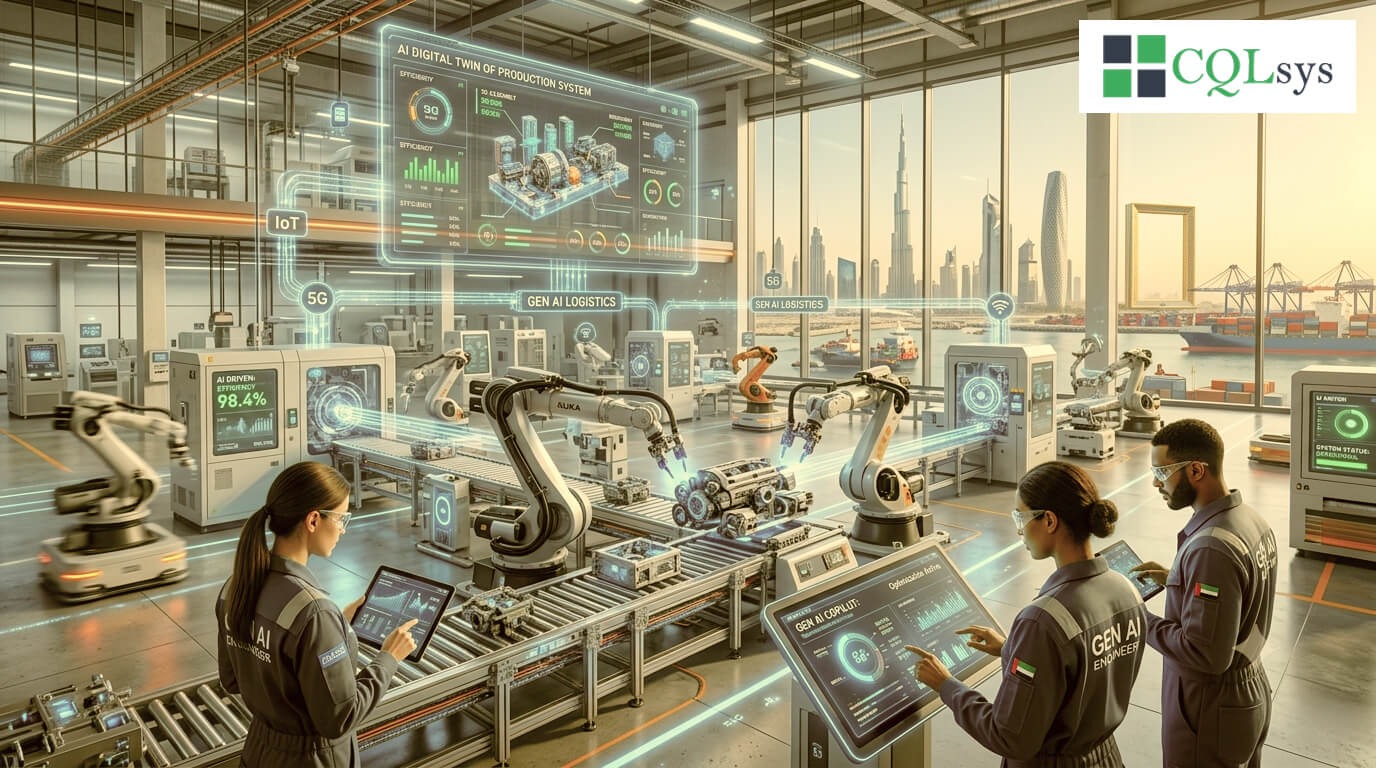
Generative AI for Manufacturing Companies in Dubai: What Industrial Innovation Looks Like in 2026
Introduction: The New Frontier of Industrial Manufacturing in Dubai
Manufacturing in the United Arab Emirates has entered a decisive era. As part of Dubai’s D33 Economic Agenda and the UAE Ministry of Industry and Advanced Technology (MoIAT) flagship Operation 300bn initiative, the industrial sector is shifting rapidly from oil-dependent economic models toward advanced high-tech production. Across major Dubai industrial hubs—including Jebel Ali Free Zone (JAFZA), Dubai Industrial City (DIC), and Dubai South—factory owners face a hyper-competitive operational environment characterized by volatile raw material costs, international trade fluctuations, strict sustainability targets, and the necessity for zero-defect quality control.
While traditional Industry 4.0 brought connected Internet of Things (IoT) sensors and predictive analytics to the factory floor, Generative AI represents a quantum leap forward. In 2026, industrial AI is no longer limited to passively monitoring sensor anomalies; it actively generates solutions, crafts optimized production schedules, designs high-performance components, and guides technician workflows in real time.
| Stage | Manufacturing Challenge / Initiative | Role of AI & Strategic Support | Expected Business Impact |
|---|---|---|---|
| 1. Industrial Challenges | Rising operational costs, skilled labour shortages, production inefficiencies, equipment downtime, and supply chain disruptions | Identify high-value AI opportunities across manufacturing operations and prioritise use cases based on ROI potential | Improved operational visibility, reduced inefficiencies, and stronger resilience |
| 2. Government & Industry Catalysts | National industrial transformation programmes and funding initiatives such as Operation 300bn, D33, and Industrial Resilience Fund | Align AI adoption strategies with regional manufacturing priorities, incentives, and digital transformation goals | Faster technology adoption and stronger competitive positioning |
| 3. Generative AI Adoption | Need for smarter automation, faster innovation cycles, and better decision-making | Deploy Generative AI solutions including synthetic data generation, generative design, AI-powered engineering assistants, and natural language copilots | Accelerated product development, enhanced workforce productivity, and intelligent operations |
| 4. Business Outcomes | Pressure to improve efficiency, quality, and profitability | Convert AI capabilities into measurable operational improvements through enterprise AI consulting and implementation frameworks | Up to 35% reduction in downtime, 60% faster design cycles, improved OEE, and measurable financial ROI |
Generative AI vs. Traditional AI in Manufacturing: What's the Difference?
Understanding the distinction between traditional predictive machine learning and generative AI is crucial for plant managers and CTOs evaluating technology investments.
| AI Approach | Process Flow | Primary Capability | Manufacturing Impact |
|---|---|---|---|
| Traditional AI (Predictive AI) | Detects anomalies → Alerts operators → Requires manual troubleshooting | Identifies abnormal equipment behaviour, predicts potential failures, and provides data-driven alerts | Helps teams respond faster to issues but relies heavily on human expertise for diagnosis and corrective action |
| Generative AI | Detects anomalies → Performs root-cause analysis → Recommends corrective actions → Generates maintenance workflows/orders | Combines operational data, engineering knowledge, and AI reasoning to provide actionable recommendations | Reduces investigation time, improves maintenance decisions, accelerates issue resolution, and supports proactive operations |
Traditional AI (Predictive Analytics)
Traditional AI systems rely on historical datasets to classify objects or forecast continuous values. On the factory floor, a traditional model might process vibration data from a CNC machine spindle and flag a 78% probability that a bearing will fail within 48 hours. However, it cannot explain why or automatically draft step-by-step repair instructions adapted to that specific machine model.
Generative AI (Cognitive Synthesis & Reasoning)
Generative AI combines multimodal foundation models with deep enterprise context. When the sensor detects an anomaly, a Generative AI copilot reads the live vibration telemetry, cross-references the historical maintenance logs stored in the ERP, scans the original equipment manufacturer (OEM) PDF manual, and outputs a complete diagnostic report. It drafts a localized repair work order in Arabic and English, provides standard operating procedures (SOPs) for the technician, and instantly generates a re-order requisition for replacement parts.
Core Generative AI Use Cases Transforming Industrial Operations in 2026
Generative AI applications span every stage of the manufacturing value chain, from raw material procurement to post-production quality assurance.
1. Generative CAD & Material-Optimized Engineering Design
Engineers enter constraints—such as payload weight, maximum stress thresholds, temperature tolerances, and material choices (e.g., titanium, lightweight aluminum alloys)—into generative design software. The generative model iterates through thousands of geometric permutations, producing organic, high-strength structural configurations that reduce component weight by up to 40% while preserving structural integrity. Manufacturers across Dubai and Munich are utilizing these capabilities to accelerate prototyping cycles for aerospace, automotive, and heavy industrial machinery.
2. Shop Floor Natural Language Copilots
Complex plant interfaces often slow down junior operators and maintenance engineers. By layering Large Language Models over SCADA and MES systems, factory personnel can query shop floor conditions using plain language via tablet or handheld industrial device:
"Show me the top three bottleneck causes on Assembly Line 4 over the last shift, and generate a step-by-step recalibration workflow for the operator."
This approach eliminates hours spent manually cross-referencing disparate data dashboards. Companies seeking custom operator interfaces often rely on specialized UI/UX Design and Development Services to ensure complex multi-lingual dashboards remain intuitive for factory teams.
3. Synthetic Data Generation for Quality Vision Inspection
Training deep learning vision models for Automated Optical Inspection (AOI) historically required capturing thousands of real-world physical defect images—a process that can take months when manufacturing high-yielding, high-precision products. Generative Adversarial Networks (GANs) and diffusion models generate hyper-realistic synthetic images of rare structural defects (hairline cracks, paint micro-voids, PCB solder bridges). This allows vision algorithms to be deployed in days with 99.8% detection accuracy.
4. Automated Root-Cause Analysis (RCA) & Maintenance Ticket Generation
When an unexpected line stoppage occurs, Generative AI models ingest real-time log data, operator shift notes, ambient temperature readings, and historical error codes to perform automated root-cause analysis. Instead of lengthy manual post-mortems, the system generates an immediate RCA report detailing the failure chain and recommending immediate corrective actions.
5. Adaptive Supply Chain Scenario Modeling
Global manufacturing hubs like Dubai, Singapore, and London remain vulnerable to international trade disruptions. Generative AI simulates complex global supply chain disruptions—such as maritime shipping lane delays or raw material shortages—and dynamically generates alternative supplier routings, recalculates production scheduling matrices, and adjusts inventory buffer levels automatically.
Industry-Specific Applications Across Key Sectors
| Industrial Sector | Primary Generative AI Use Case | Core Business Outcome |
|---|---|---|
| Automotive & Mobility | Generative chassis design, lightweighting, synthetic crash test simulation | 30% reduction in vehicle R&D cycles; lower material usage |
| Food & Beverage (F&B) | Recipe formulation optimization, automated batch consistency checks | Reduced ingredient waste, strict compliance with UAE food safety codes |
| Pharmaceuticals & Chemicals | Molecular synthesis simulation, automated regulatory documentation | 50% faster batch record validation; seamless compliance auditing |
| Metals & Construction Materials | Thermal stress generation modeling, real-time energy usage synthesis | Optimized furnace energy consumption; reduced carbon intensity |
| Electronics & Packaging | PCB design layout generation, synthetic optical defect training | 99.9% quality pass rate on high-speed packaging lines |
Whether operating a pharmaceutical plant in Dubai Science Park or a steel manufacturing facility in Chicago or Abu Dhabi, integrating bespoke software solutions ensures seamless data flow across legacy hardware. Learn how customized software architecture empowers industrial agility on our Website Development Company page.
Interactive ROI & Cost Savings Calculator for Manufacturing Leaders
To help plant managers, CFOs, and digital transformation leaders estimate the potential financial impact of deploying Generative AI models across their factory lines, use this visual modeling spec.
Comprehensive Comparison: Traditional Manufacturing vs. AI-Powered Smart Manufacturing
The shift from manual, siloed factory setups to cognitive, AI-powered industrial ecosystems redefines factory metrics.
| Operational Function | Traditional Manufacturing | Generative AI-Powered Smart Manufacturing | Impact & Savings |
|---|---|---|---|
| Component Design | Manual CAD iterations; trial-and-error physical prototyping. | Generative CAD synthesis based on stress and material constraints. | 50–70% faster R&D phase; up to 35% lighter components. |
| Machine Maintenance | Scheduled preventive maintenance or reactive emergency repairs. | Generative predictive copilots with natural language diagnostics. | 25–35% reduction in total unscheduled downtime costs. |
| Quality Control | Manual visual sampling or rigid rule-based vision systems. | Generative vision models trained on synthetic defect data. | 99.8%+ defect detection rate at full production speed. |
| Shop Floor Operations | Paper manuals, complex SCADA interfaces, high onboarding time. | Multilingual conversational LLM copilots integrated into edge devices. | 60% faster operator onboarding; zero language barriers. |
| Supply Chain Planning | Static spreadsheet forecasts; reactive response to delays. | Generative agentic scenario planning with real-time route adjusting. | 15–20% reduction in holding inventory costs. |
| Regulatory Compliance | Manual batch record gathering; time-consuming audit prep. | Automated generation of batch documentation and safety audit reports. | 80% faster audit reporting; full traceability. |
15 Key Benefits of Generative AI for Dubai Manufacturers
- Substantial Reduction in Downtime: Predicts equipment component degradation and generates maintenance steps before fatal breakdowns occur.
- Accelerated Product Development: Reduces CAD design time from weeks to hours, allowing rapid prototyping for regional and export markets.
- Enhanced Quality Control Accuracy: Synthetic defect training equips computer vision systems to catch microscopic flaws on high-speed lines.
- Democratized Shop Floor Knowledge: Translates decades of senior engineering expertise into searchable, interactive LLM knowledge bases.
- Reduced Raw Material Scrap: Generative path optimization for CNC machining and additive manufacturing reduces material waste by up to 30%.
- Optimized Energy Consumption: Generative algorithms model thermodynamic and electrical loads to run energy-intensive machinery during off-peak tariff windows.
- Streamlined Regulatory Compliance: Generates fully audit-compliant documentation aligned with UAE MoIAT specifications and ISO quality standards.
- Bridge for Skilled Labor Shortages: Empowers entry-level workers by offering step-by-step augmented repair and assembly instructions.
- Smarter Warehouse & Logistics: Generates optimal packing configurations and robotic picking paths within distribution hubs.
- Multilingual Workforce Enablement: Instantly translates technical documentation between English, Arabic, Hindi, Tagalog, and Urdu for shop floor workers.
- Customized Batch Production: Enables economic low-volume, highly customized production runs without requiring manual tool re-indexing.
- Real-time Root Cause Analysis: Shrinks line-stoppage post-mortem investigations from days to seconds.
- Alignment with UAE Industrial Strategy: Positioned directly to capitalize on incentives provided under the National Industrial Resilience Fund.
- Enhanced Data Security at Edge: Private local LLMs ensure sensitive proprietary product designs never leave the secure corporate network.
- Maximum Overall Equipment Effectiveness (OEE): Harmonizes maintenance, line speed, and material feed rates to sustain optimal plant throughput.
To achieve these operational gains, enterprise leaders rely on our dedicated Generative AI Development Services to construct custom foundation models tuned to proprietary industrial telemetry.
Step-by-Step Implementation Roadmap for Dubai Manufacturers
Transitioning a traditional factory into an AI-powered smart enterprise requires a structured execution framework.
Phase 1: AI Readiness Audit & Strategy Blueprint
Prerequisite for government fund qualification.
Audit existing operational data infrastructure across SCADA, MES,
and ERP systems. Identify high-value operational bottlenecks (e.g.,
specific line downtime or excessive scrap rates) and establish clear
Baseline KPIs.
Phase 2: Data Architecture Modernization & Edge Infrastructure
Essential for ultra-low latency inference.
Deploy edge computing nodes across factory floors and securely
connect operational technology (OT) networks with cloud systems.
Ensure full compliance with UAE Federal Decree-Law No. 45/2021
regarding data protection and regional storage.
Phase 3: Custom LLM Fine-Tuning & Synthetic Data Pipelines
Building domain-specific intelligence.
Ingest legacy maintenance manuals, standard operating procedures,
historical work orders, and engineering schematics into a secure
Retrieval-Augmented Generation (RAG) pipeline. Generate synthetic
defect image sets for vision inspection.
Phase 4: Pilot Deployment & Operational Testing
Risk-free execution on a single production line.
Deploy natural language plant copilots and generative maintenance
tools on a controlled pilot production line. Benchmark real-world
performance against initial KPI metrics and collect direct
shop-floor operator feedback.
Phase 5: Enterprise Scaling & Change Management
Full rollout across multi-site facilities.
Scale successful pilot solutions across all plant lines and
secondary sites (e.g., expanding from Dubai Industrial City to
facilities in Riyadh or Zurich). Conduct continuous operator
training and refine agentic guardrails.
Overcoming Key Implementation Challenges in UAE Industrial Environments
While the advantages are transformational, manufacturing leaders must navigate several technical and organizational hurdles during deployment.
Challenge 1: Integration with Legacy OT/IT Systems
- The Issue: Many manufacturing plants operate machinery equipped with legacy PLCs and proprietary SCADA software that lack native API interfaces.
- The Solution: Utilize custom API layer wrappers and edge IoT gateways to translate serial bus signals into structured telemetry. Explore our comprehensive Internet of Things (IoT) services to securely bridge physical hardware with cloud analytics.
Challenge 2: Hallucination Risks in High-Safety Industrial Environments
- The Issue: In incorrect contexts, an unconstrained Large Language Model might generate inaccurate torque specifications or erroneous operating parameters, presenting severe safety risks.
- The Solution: Implement strict deterministic guardrails and Retrieval-Augmented Generation (RAG). The LLM is restricted to drawing technical facts solely from verified OEM manuals and validated plant SOPs, with a human-in-the-loop requirement for critical control actions.
Challenge 3: Industrial Data Sovereignty & Server Security
- The Issue: Transmitting proprietary component blueprints and plant telemetry across international cloud servers creates cybersecurity vulnerabilities and regulatory risks under UAE law.
- The Solution: Deploy private, on-premise foundation models or localized cloud instances within UAE-based data centers, protected by robust protocols. Discover how our Server Security Services safeguard high-value enterprise infrastructure against cyber threats.
Emerging Future Trends Shaping Industrial AI in 2026 and Beyond
As we move through 2026, several next-generation technological innovations are converging to reshape industrial manufacturing in Dubai and global industrial centers such as San Francisco, Toronto, and Stockholm:
| AI Evolution Stage | Process Flow | Primary Capability | Manufacturing Impact |
|---|---|---|---|
| Agentic AI Workflows | AI agents analyse operational data → Make decisions → Execute defined tasks → Continuously optimise processes | Enables autonomous AI systems that can plan, coordinate, and perform multi-step workflows with minimal human intervention | Improves operational efficiency, reduces manual workload, accelerates decision-making, and enables intelligent automation |
| Cognitive Digital Twins | Real-time factory data integration → AI-powered simulation and prediction → Continuous optimisation of processes and assets | Creates intelligent virtual replicas of manufacturing systems that understand, predict, and recommend improvements | Enables predictive operations, optimised production planning, reduced downtime, and improved resource utilisation |
| Fully Autonomous Micro-Factories | AI-driven planning → Autonomous production scheduling → Self-optimising machines → Automated quality control and execution | Combines robotics, AI agents, digital twins, and real-time analytics to create self-operating manufacturing environments | Enables flexible production, faster response to demand changes, reduced operational costs, and next-generation smart manufacturing |
Why Choose CQLsys Technologies for Generative AI Development
Navigating the transition to AI-driven industrial manufacturing requires a technology partner capable of bridging advanced software engineering with real-world operational challenges.
Enterprise Engineering Excellence
At CQLsys Technologies, we combine deep domain expertise in AI engineering, custom software development, and industrial IoT connectivity. Our teams design robust, scalable, and secure applications tailored to the specific needs of modern enterprises.
Our Comprehensive Capabilities
- Custom AI & LLM Engineering: Domain-specific model fine-tuning, RAG system design, and private deployment architectures.
- Industrial Application Development: Modern web and mobile applications designed for rugged factory tablets and mobile workforces. Explore our Mobile Application Development Services to empower shop floor personnel with real-time diagnostic tools.
- End-to-End Enterprise Integration: Connecting legacy ERPs (SAP, Oracle) seamlessly with modern IoT networks and AI agents.
- Dedicated Agile Engineering Squads: Flexible scaling options for enterprise clients requiring dedicated software engineering units.
To review our track record of delivering transformative software solutions for industry leaders across the GCC, North America, and Europe, explore our global Portfolio or stay up to date with technology trends on our Official Technology Blog. Connect with our executive leadership team on LinkedIn and follow our technical insights on X (formerly Twitter) and Facebook.
Frequently Asked Questions (FAQs)
-
How does Generative AI differ from standard Industry 4.0
automation?
Standard Industry 4.0 automation connects sensors to monitor production metrics and trigger static alerts based on predefined rule sets. Generative AI introduces cognitive reasoning, synthetic content creation, and problem-solving capability. Instead of merely alerting an operator to a machine malfunction, Generative AI analyzes SCADA logs, consults OEM manuals, synthesizes a diagnostic report, drafts localized work orders, and recommends immediate corrective workflows. -
How does Generative AI align with the UAE’s Operation
300bn strategy?
Operation 300bn aims to expand the UAE industrial sector’s GDP contribution to AED 300 billion by 2031, emphasizing advanced manufacturing, higher local productivity, and sustainable innovation. Generative AI directly supports these targets by reducing operational waste, cutting plant downtime, accelerating localized product design, and optimizing resource efficiency—qualifying adopting companies for funding initiatives under the UAE’s National Industrial Resilience Fund. -
Can Generative AI integrate with legacy ERP and MES
systems like SAP or Oracle?
Yes. Modern Generative AI architectures do not require replacing functional ERP, MES, or SCADA infrastructure. Middleware API layers, custom data pipelines, and edge computing gateways extract unstructured telemetry and operational logs from legacy systems. RAG frameworks ingest this data to provide AI copilots with context without disrupting underlying database integrity. -
What are the primary data security and privacy
considerations for Dubai factories?
Industrial facilities handle sensitive IP, component blueprints, and proprietary operational logs. To maintain strict compliance with UAE Federal Decree-Law No. 45/2021 regarding personal data protection, manufacturers should deploy private, localized LLMs or secure cloud instances housed in local UAE data centers. End-to-end data encryption, role-based access control (RBAC), and strict enterprise firewalls ensure proprietary data remains protected. -
How long does it take to see a measurable ROI from
Generative AI implementation?
Most manufacturing companies achieve measurable financial returns within 6 to 12 months following initial deployment. Early ROI is typically realized through reduced unscheduled line downtime, accelerated onboarding for technical operators, lower material scrap rates, and faster quality control cycles on production lines. -
What is synthetic data, and how does it help quality
inspection in manufacturing?
Synthetic data consists of photorealistic, artificially generated images of defective manufactured components created by diffusion models or GANs. Capturing thousands of real physical defects on high-yield production lines can take months. Generative models create realistic defect examples in hours, allowing computer vision systems to train rapidly and achieve high inspection accuracy before physical line startup. -
How does Generative AI impact shop-floor workers and
labor dynamics?
Generative AI acts as a force multiplier for factory personnel rather than a replacement. Multilingual copilots assist operators by rendering technical manuals and diagnostic instructions accessible via tablet interfaces in native languages. Junior technicians can resolve complex mechanical issues independently, mitigating regional skilled labor shortages and boosting overall plant safety. -
What is the typical financial investment required to
deploy Generative AI in a factory?
Investment levels depend on plant scale, existing data maturity, and project scope. Focused proof-of-concept (PoC) pilot projects—such as a single-line LLM maintenance copilot—typically start at modest budgets. Enterprise-wide deployments involving private foundation models, synthetic vision data pipelines, and deep MES integrations scale according to plant capacity, yielding high returns via operational cost savings. -
Which manufacturing sub-sectors in Dubai benefit most
from Generative AI?
Generative AI delivers significant advantages across high-value industrial sectors, including Food & Beverage (batch recipe consistency and safety audits), Automotive & Aerospace (generative CAD component design), Pharmaceuticals (batch record automation), Heavy Metals & Building Materials (energy load optimization), and Electronics/Packaging (high-speed synthetic vision quality inspection). -
What steps should a plant manager take to begin an AI
transformation project?
Plant managers should begin by conducting a comprehensive AI readiness audit to identify specific operational bottlenecks, such as frequent downtime or high scrap rates. Next, centralize unstructured operational data (logs, manuals, maintenance histories), define clear success metrics, and partner with an experienced AI consultancy to build a risk-managed, phased proof-of-concept before full-scale deployment.
Strategic Call to Action (CTA)
Ready to Build Your Smart Industrial Future in Dubai?
Whether you manage an industrial facility in Dubai Industrial City, JAFZA, Abu Dhabi, or lead digital transformation across global markets, adopting Generative AI is the definitive strategy for maintaining market leadership in 2026.
Partner with CQLsys Technologies to build secure, scalable, and domain-tuned AI solutions customized for your manufacturing infrastructure.
- Schedule a Free Strategy Consultation with Our AI Experts
- Request a Customized Project Quote
- Explore our recent work on our Global Portfolio Page
To gain additional visual perspective on how foundation models and cognitive systems are reshaping global factory floors, watch this detailed guide on How Generative AI is Revolutionizing Manufacturing, which offers valuable insights into integrating AI-driven design and production workflows.