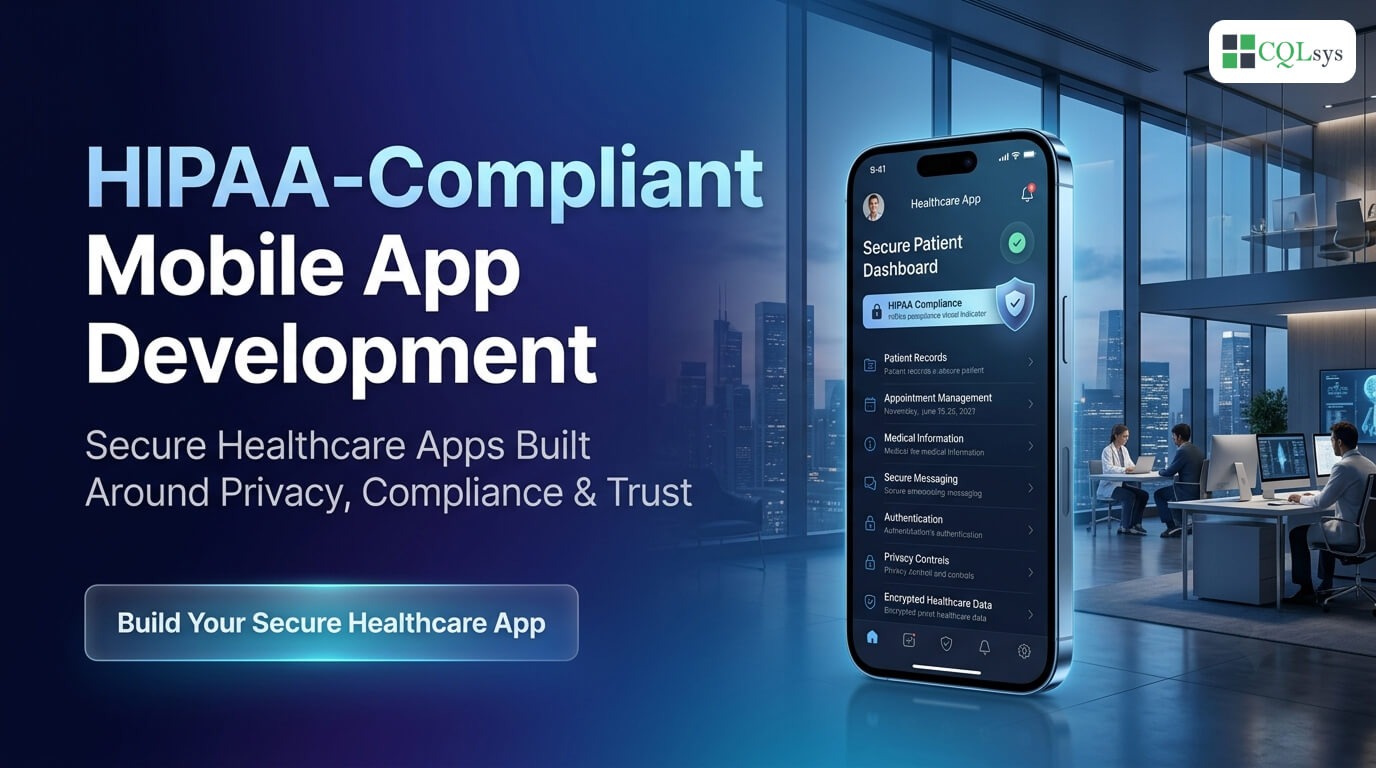
HIPAA-Compliant Mobile App Development: Technical Checklist for Healthcare Founders
Building a successful HealthTech platform requires balancing rapid product development with uncompromising data protection standards. For healthcare startup founders and technical leaders, regulatory compliance represents one of the most critical operational hurdles. A single security misconfiguration can result in severe financial penalties, reputational damage, and legal liability under the Health Insurance Portability and Accountability Act.
Achieving complete compliance is not merely an administrative exercise; it demands deliberate structural engineering. Establishing a robust HIPAA compliant mobile app checklist enables executive teams to address mandatory technical safeguards from day one. By embedding security directly into your architecture, you protect electronic Protected Health Information, maintain patient trust, and build an enterprise-ready product capable of earning institutional partnerships.
Understanding Technical HIPAA Safeguards for Mobile Applications
The HIPAA Security Rule defines specific technical safeguards that govern how electronic Protected Health Information must be created, received, maintained, or transmitted. Unlike general consumer applications, healthcare platforms must adhere to strict administrative, physical, and technical standards.
Primary Security Framework Pillars:
- Administrative Safeguards: Formal security management processes, risk analyses, information access policies, and ongoing workforce training.
- Physical Safeguards: Facility access controls, physical workstation security policies, and strict device media protections.
- Technical Safeguards: Technology policies and systems that control software access, data integrity, system activity logs, and transmission protection.
For founders, understanding these technical controls is essential to guiding product engineering teams:
- Access Controls: Restricting system entrance strictly to authorized personnel using unique identifiers, multi-factor verification, and role-based permissions.
- Audit Controls: Implementing mechanisms to record, store, and analyze system activities, database reads, updates, and authentication events.
- Data Integrity: Enforcing measures to ensure electronic records remain unaltered, uncorrupted, and protected from unauthorized destruction.
- Transmission Security: Guarding transmitted data against unauthorized access over public networks using advanced cryptographic protocols.
Technical Checklist: Critical Safeguards for HealthTech Apps
Implementing compliance within a mobile architecture requires addressing vulnerabilities across the user device, network APIs, and backend databases. The following engineering checklist outlines the core technical implementations required for regulatory clearance.
1. Robust Access Controls and Authentication
Unauthorized access remains the primary vector for health data breaches. Secure your application entry points using modern identity architecture:
- Unique User Identification: Every user—whether patient, provider, or administrator—must possess a unique system identifier. Shared credentials are strictly prohibited.
- Multi-Factor Authentication (MFA): Require MFA for all user logins using time-based one-time passwords (TOTP), SMS codes, or hardware keys.
- Biometric Access Integration: Utilize native iOS Touch ID/Face ID and Android Biometric Prompt features. Biometric mechanisms must act strictly as local access tokens that unlock secure local credentials rather than replacing backend validation.
- Role-Based Access Control (RBAC): Restrict system privileges based on user roles. Patients must access only their personal health history, while medical personnel access records bound explicitly to active treatment contexts.
- Automatic Session Timeout: Enforce mandatory automatic logout or screen locking after a designated period of inactivity (typically two to five minutes). Clear active session state from volatile device memory upon termination.
2. Comprehensive Encryption Architecture
Data must remain encrypted across its entire lifecycle—at rest on the mobile device, during transmission across public networks, and within cloud storage databases.
| Compliance State | Mandatory Standard | Engineering Implementation |
|---|---|---|
| Data in Transit | TLS 1.3 (or TLS 1.2 minimum) | Enforce HTTPS endpoint configuration; implement SSL Pinning on mobile clients to block Man-in-the-Middle attacks. |
| Data at Rest (Device) | AES-256 Bit Encryption | Utilize platform keychains (iOS Keychain / Android Keystore) for keys; minimize local storage of health information. |
| Data at Rest (Database) | AES-256 / Cloud KMS | Apply hardware-backed database encryption via cloud key management services (AWS KMS, Azure Key Vault). |
| Data in Memory | Volatile Storage Management | Clear cached records, system clipboards, and app switcher preview snapshots immediately after view termination. |
3. Comprehensive Audit Trails and System Logging
HIPAA regulations mandate complete traceability of interactions involving sensitive health records. Audit logs must capture sufficient operational metadata to enable forensic reconstruction following any security event.
- Event Scope: Log every login attempt (successful and failed), data read operation, modification, deletion, permission update, and data export request.
- Log Metadata Payload: Every log entry must capture an accurate timestamp, the acting User ID, originating IP address, device signature, action performed, and affected record IDs.
- Payload Sanitization: Never write raw health details, personal information, or user passwords into application logs.
- Immutability: Route log streams to isolated, read-only cloud storage buckets configured with Write Once Read Many (WORM) policies.
- Retention Enforcement: Retain security log records for a minimum of six years to meet statutory compliance requirements.
4. Application Hardening and Data Leakage Prevention
Consumer apps often leak data to underlying operating system services through routine features. Healthcare apps must explicitly disable these points of disclosure:
- Screenshot Blockers: Disable native OS screenshot capabilities on screens displaying sensitive records. Apply secure canvas overlays when the application transitions to the background.
- Clipboard Protection: Prevent copy-paste functionality on sensitive fields to stop data leakage to third-party keyboards or system clipboards.
- Notification Security: Ensure push notifications convey status updates without exposing private details (e.g., display "You have a new message from your clinic" rather than specific clinical notes).
- Third-Party Analytics Controls: Standard commercial analytics platforms harvest diagnostic metrics that can violate regulations if unconfigured. Disable default automatic collection features and execute a Business Associate Agreement before sharing diagnostic payloads with external vendors.
Solution Architecture: End-to-End Compliance Design
A compliant architecture uses a defense-in-depth model, separating presentation systems from core databases through hardened security boundaries.
High-Level System Architecture Flow
Mobile Application Client → TLS 1.3 SSL Pinning Gateway → Web Application Firewall & CDN → OAuth 2.0 Auth Server → Isolated Microservices Layer → Encrypted Primary Database & Immutable SIEM Audit Logs
Architectural Component Breakdown
- User & Mobile Presentation Layer: The native iOS or Android client interface handles user interactions, manages local biometric sessions, and processes view layers. Sensitive state is never cached to local disk storage; it resides solely in volatile memory during active app use.
- Edge Security & Network Gateway: Incoming API calls pass through Web Application Firewalls (WAF) and content distribution layers. This layer mitigates DDoS attacks, inspects traffic patterns, terminates TLS, and forwards sanitized web requests.
- Application & Authentication Services: Backend business logic operates within isolated cloud environments. The identity server validates OAuth 2.0 tokens for every request, verifying scope permissions before granting access to application resources.
- Data Storage & Key Management: Primary health databases process queries over isolated internal connections. Data fields and database volumes are encrypted using keys hosted in dedicated Key Management Services (KMS), rotated regularly according to administrative schedules.
- Audit & SIEM Services: System events are piped via asynchronous message queues to isolated log aggregators and Security Information and Event Management (SIEM) engines for continuous compliance monitoring.
Technology Stack Recommendations for Compliant Platforms
Selecting enterprise-grade frameworks ensures long-term system stability, developer ecosystem support, and native integration with cloud security services.
| Layer | Recommended Technology | Compliance & Operational Rationale |
|---|---|---|
| Mobile Client | Flutter / React Native / Swift / Kotlin | Cross-platform frameworks reduce vulnerability exposure across platforms; native APIs provide secure storage access. |
| Backend Services | Node.js / Python / Go / .NET Core | Enterprise frameworks with mature security ecosystems, secure HTTP header handling, and robust ORM libraries. |
| Database Layer | PostgreSQL / Amazon Aurora / MongoDB Atlas | Support native enterprise encryption features, field-level encryption, role-based access control, and automated backups. |
| Cloud Hosting | Amazon Web Services (AWS) / Azure | Enterprise infrastructure platforms offering comprehensive BAA coverage across computing, networking, and storage components. |
| Identity Management | AWS Cognito / Auth0 Enterprise / Okta | Provides turnkey, compliant user directory services with native MFA, session management, and RBAC support. |
| Logging & SIEM | AWS CloudTrail / Datadog / Splunk | Delivers immutable event collection, anomaly alerting, and automated retention policy enforcement. |
Implementation Roadmap for HealthTech Founders
Engineering a compliant application requires structured technical milestones. Following a phase-based development workflow helps prevent costly architectural re-engineering prior to market launch.
- 1. Phase 1 — Discovery & Risk Assessment: Define electronic Protected Health Information scope, create data flow diagrams, and complete the initial compliance risk analysis.
- 2. Phase 2 — System Architecture & Vendor Selection: Establish security threat models, configure isolated VPC networks, and sign Business Associate Agreements with cloud vendors.
- 3. Phase 3 — Core Development & Hardening: Build application features, implement role-based access controls, set up AES-256 encryption, and configure immutable logging.
- 4. Phase 4 — Quality Assurance & Security Audit: Perform thorough static code reviews, automated vulnerability scans, and third-party ethical penetration testing.
- 5. Phase 5 — Deployment & Continuous Governance: Launch the software into production using secure pipelines, enable continuous SIEM monitoring, and set up automated incident response plans.
Cost Considerations and ROI Impact
Building security into early technical architecture requires upfront capital investment, but it protects startups from catastrophic financial and operational liabilities over time.
Primary Development Cost Drivers
- Infrastructure Provisioning: Dedicated compliant cloud instances, key management infrastructure, and SIEM monitoring configurations add base operating costs.
- Third-Party Audits: Engaging certified independent compliance firms for formal penetration tests and security assessments represents a recurring capital commitment.
- Enterprise Integrations: Integrating secure identity providers, specialized diagnostic services, and electronic health record (EHR) integrations demands specialized engineering resources.
Business Value and ROI
- Accelerated Institutional Sales: A verified compliant infrastructure simplifies enterprise procurement processes, enabling startups to sell software directly to hospital networks and insurers.
- Risk Mitigation: Preventing security breaches protects companies from significant regulatory fines, costly legal defense fees, and operational downtime.
- Increased Company Valuation: Enterprise clients, venture capital funds, and strategic acquirers assign premium valuations to software assets supported by documented security frameworks.
Why Choose CQLsys Technologies for Healthcare App Engineering
Building a compliant mobile application requires specialized engineering skills and a thorough understanding of health tech security protocols.CQLsys Technologies provides complete technical services to help healthcare founders convert complex software requirements into secure, market-ready digital products.
Our team brings deep domain expertise across mobile app development and custom software development. We design resilient platform architectures that prioritize patient privacy without compromising user experience. From initial threat modeling and cloud setup to third-party integrations and backend hardening, we ensure every layer of your application meets rigorous security standards.
Learn more about our engineering experience by visiting our About Us page, or explore technical guides on our blog.
Frequently Asked Questions
1. How do founders ensure mobile app HIPAA compliance?
Founders ensure compliance by implementing administrative policies, physical cloud safeguards, and technical software controls. Key steps include conducting threat assessments, selecting infrastructure vendors willing to sign Business Associate Agreements, configuring end-to-end data encryption, building comprehensive access controls, and conducting third-party vulnerability audits prior to product launch.
2. What technical safeguards are required for healthcare apps?
Mandatory technical safeguards include user authentication protocols, multi-factor verification, role-based access management, automatic session terminations, AES-256 data encryption at rest, TLS 1.3 transmission security, tamper-proof audit trails, and hardware-backed cryptographic key management systems.
3. Is cloud storage automatically HIPAA compliant out of the box?
No. While cloud platforms like AWS, Azure, and Google Cloud provide compliant infrastructure, hosting data on these platforms does not make your application automatically compliant. Founders must correctly configure network access controls, enable volume-level encryption, enforce access policies, and execute a signed Business Associate Agreement with the provider.
4. What encryption is mandatory for Protected Health Information?
HIPAA requires implementing reasonable and appropriate encryption mechanisms for protected information. Industry standards dictate using AES-256 encryption for data stored in local keychains, backend databases, and backups. Data transmitted over public networks must use secure protocols such as HTTPS powered by TLS 1.2 or TLS 1.3.
5. How long should audit logs be retained for HIPAA compliance?
HIPAA administrative requirements specify that compliance documentation, system activity records, access logs, and audit trails must be retained for a minimum of six years from the date of creation. Log storage systems should enforce immutable WORM retention rules to ensure records remain unalterable.
6. Do third-party APIs need a Business Associate Agreement?
Yes. Any third-party software service, API, analytics platform, cloud service, or communication provider that processes, transmits, or stores protected health data on behalf of your application must sign a formal Business Associate Agreement before handling live production traffic.
7. How does automatic logout function in a healthcare app?
Automatic logout tracks user inactivity on the device. When no user input occurs within a set period (typically two to five minutes), the app terminates the active session state, clears cached records from volatile memory, closes secure sockets, and returns the application to an authenticated login screen requiring passcode or biometric verification.
8. What is the cost of building a HIPAA-compliant mobile app?
Development costs vary based on feature complexity, cross-platform requirements, and third-party EHR integrations. Basic healthcare MVPs typically range from $40,000 to $80,000, while complex enterprise health platforms with custom integrations can exceed $150,000. Incorporating compliance controls adds approximately 20% to 30% to baseline engineering budgets.
9. What happens if a mobile app violates HIPAA regulations?
Violations incur financial penalties from the HHS Office for Civil Rights, ranging from $100 to over $50,000 per record breach, with maximum annual penalties reaching $1.5 million. Beyond fines, non-compliant platforms face mandatory corrective action plans, potential lawsuits, loss of operating licenses, and significant brand damage.
10. Why is local data storage risky for mHealth applications?
Local storage on mobile devices poses significant security risks because smartphones can be lost, stolen, or compromised by malware. Storing unencrypted health records on a local file system exposes sensitive data to unauthorized extraction. Developers should avoid storing health data on local storage devices whenever possible, relying instead on secure ephemeral memory sessions.
Ready to build a secure, enterprise-grade healthcare mobile application?
Protecting patient privacy and meeting regulatory requirements demands an experienced software engineering team.
Download the Full Engineering HIPAA Checklist & Book a Security Audit.
Our senior technology team is ready to analyze your platform architecture, review technical compliance requirements, and help bring your product to market securely.
- Schedule a Strategic Review: Contact CQLsys Technologies
- Connect on LinkedIn: CQLsys Technologies LinkedIn Page
- Follow Us on Social Media: Facebook | Instagram