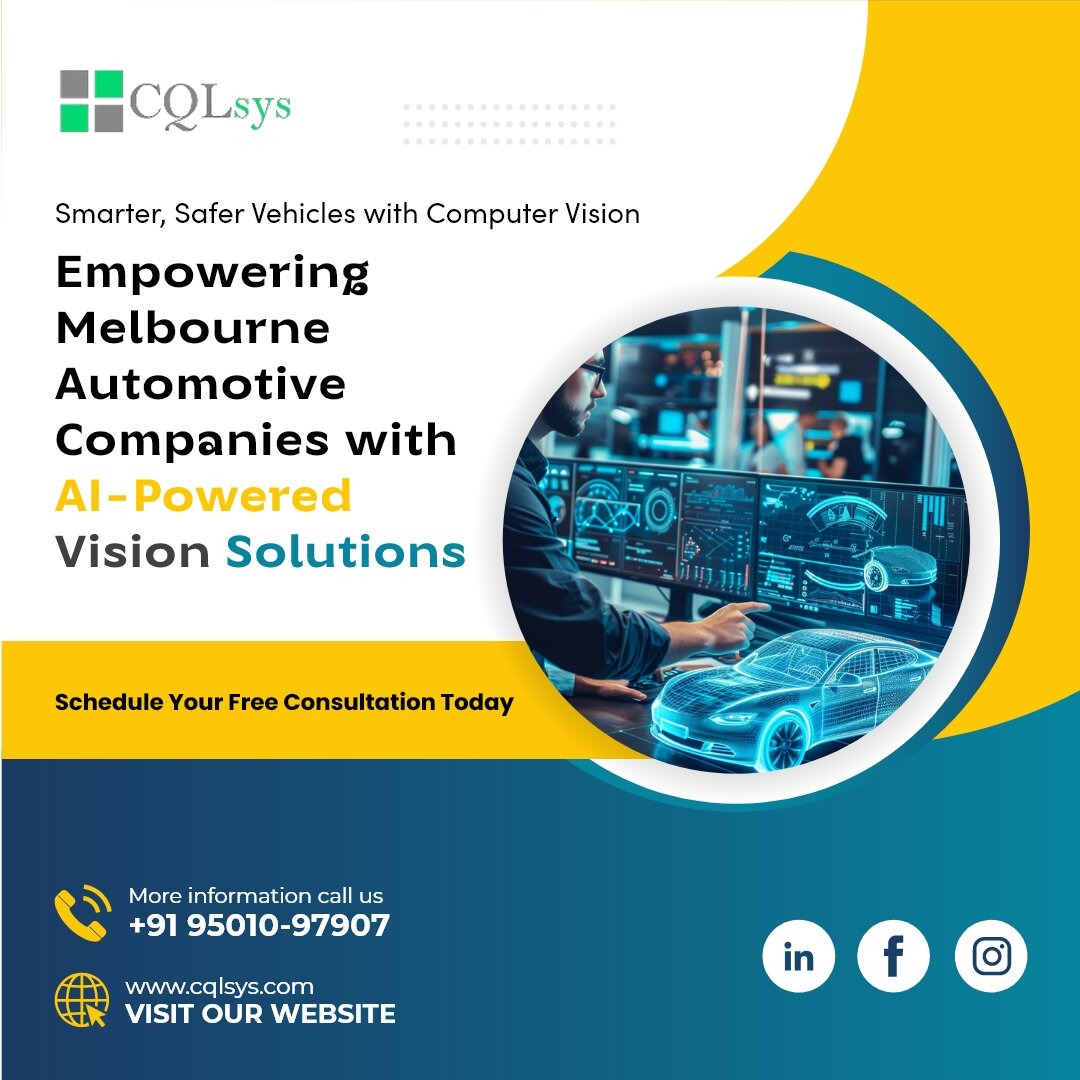
Computer Vision for Automotive Companies in Melbourne: Making Vehicles Smarter and Safer
Melbourne’s automotive sector is navigating an unprecedented transition toward software-defined vehicles, electric fleets, and autonomous mobility. For original equipment manufacturers (OEMs), Tier-1 suppliers, and commercial fleet operators across Victoria, traditional safety mechanisms and manual assembly inspections are no longer sufficient. Leveraging computer vision for automotive companies in Melbourne provides a path to automated hazard detection, streamlined manufacturing quality control, and intelligent fleet diagnostics.
Integrating real-time image processing and deep learning into vehicles helps local firms meet stringent Australian Design Rules (ADR) and global safety standards while reducing operational overhead. High-performance visual processing requires robust engineering across both edge hardware and cloud environments. At CQLsys Technologies, we engineer custom visual processing systems that turn raw camera streams into actionable safety features and operational intelligence.
Advanced Driver Assistance Systems (ADAS) and In-Cabin Safety
Modern vehicles demand real-time situational awareness to operate safely on urban roads and transit corridors across Victoria. Implementing vehicle object detection AI allows modern vehicles to process environmental data within milliseconds, identifying pedestrians, cyclists, road signs, and lane boundaries under varied lighting and weather conditions.
+------------------+     +-----------------------+     +-----------------------+
| Camera / LiDAR   | --> | Edge Inference (CUDA) | --> | CAN Bus / Vehicle Control |
| Sensor Feeds     |     | Sensor Data Fusion    |     | Steering, Braking, Alert  |
+------------------+     +-----------------------+     +-----------------------+
Autonomous vehicle software development focuses on reducing cognitive load for drivers while preventing collisions through automated intervention.
- Pedestrian & Obstacle Detection: Custom YOLO and RetinaNet models optimized for low-latency processing identify hazards in dense urban settings.
- AI Driver Monitoring Systems: Infrared in-cabin visual tracking analyzes driver fatigue, eye gaze, distraction, and posture to issue immediate auditory or visual alerts, aligning with AI driver safety monitoring software guidelines.
- Blind Spot & Surround View Processing: Multi-camera stitching offers 360-degree visibility, assisting with commercial vehicle parking, reversing, and tight-space maneuvering.
- Traffic Sign & Lane Recognition: Real-time extraction of speed limits, road markings, and construction detours feeds directly into active lane-keeping systems.
Building robust ADAS solutions requires adherence to functional safety protocols such as ISO 26262 and AUTOSAR architectures. Engineers developing ADAS software development Australia projects prioritize fail-operational code structure, ensuring that vision-based safety loops maintain high availability even during partial sensor degradation. Furthermore, combining visual cameras with LiDAR units creates a resilient data fusion model that ensures operational reliability across Melbourne's shifting weather conditions.
Smart Manufacturing, Assembly Inspection, and Fleet Logistics
Beyond on-road applications, computer vision is changing industrial production lines and commercial transport hubs across industrial corridors such as Dandenong and Campbellfield. Vehicle manufacturing plants and component suppliers deploy automated quality inspection automotive workflows to catch structural defects long before vehicles leave the factory floor.
+-------------------------+     +----------------------------+     +------------------------+
| Factory / Fleet Camera  | --> | Deep Learning Inspection   | --> | Automated Defect Flag /|
| High-Resolution Stream  |     | Anomaly Detection Pipeline |     | Telematics Dashboard   |
+-------------------------+     +----------------------------+     +------------------------+
Integrating machine vision manufacturing Victoria frameworks into production facilities reduces manual review cycles and eliminates costly component recalls. Custom inspection platforms assess paint uniformity, panel alignment gaps, weld integrity, and sub-assembly correctness at line speed.
| Inspection Domain | Traditional Method | Vision-AI Powered Method | Primary Operational Benefit |
|---|---|---|---|
| Body & Paint Quality | Manual Visual Spot-Checks | High-Resolution Surface Anomaly Detection | Eliminates micro-scratch missed defects |
| Component Assembly | Physical Gauge Measuring | 3D Spatial Pattern Alignment & Verification | Reduces line-cycle inspection time by 65% |
| Fleet Asset Integrity | Manual Yard Walkarounds | AI vehicle inspection automation via Scanning Portals | Identifies tire wear & body damage automatically |
| Cargo Tracking | Barcode Scanning & Paper Logs | Vision based vehicle tracking systems | Tracks volume capacity & load stability live |
For commercial logistics operations, computer vision fleet management Australia platforms deliver comprehensive operational oversight. Depots equipped with automated optical portals scan incoming trucks for tire wear, chassis damage, and license plate accuracy without forcing vehicles to stop. Inside the cabin, automotive fleet telematics AI continuously monitors cargo stability and driver behavior, transmitting alerts to central dispatch centers via cloud connectivity. Enterprise teams requiring comprehensive digital platforms can explore our full range of enterprise software development services to integrate vision pipelines directly into existing ERP and logistics platforms.
Technical Architecture: Tech Stacks, Sensor Fusion, and Edge AI
Building scalable automotive vision architectures requires balance between edge processing speed and cloud training infrastructure. Vehicles operate in real-time environments where latency must remain below 15 milliseconds for critical safety decisions. Consequently, Edge AI automotive Melbourne systems process raw camera streams locally on dedicated hardware rather than relying on cloud communication.
+-----------------------------------------------------------------------------------+
|                           Vehicle Edge Hardware Platform                          |
| +-------------------+      +----------------------+      +--------------------------+ |
| | Cameras & Sensors |  --> |  Sensor Data Fusion  |  --> | TensorRT / CUDA Engine | |
| |  (OpenCV / ROS2)  |      |   (Camera + LiDAR)   |      | (YOLO, ResNet Pipelines) | |
| +-------------------+      +----------------------+      +--------------------------+ |
+-----------------------------------------------------------------------------------+
                                        |
                         (Low-Bandwidth Telematics Uplink)
                                        v
+-----------------------------------------------------------------------------------+
|                           Cloud Infrastructure (AWS/Azure)                        |
| +-----------------------------------------------------------------------------+   |
| |    Model Re-Training, Synthetic Data Generation & Telematics Analytics      |   |
| +-----------------------------------------------------------------------------+   |
+-----------------------------------------------------------------------------------+
Engineers build model inference pipelines using standard frameworks optimized for automotive hardware acceleration:
- Programming Languages & Frameworks: C++ for low-latency system components, Python for rapid model development, and PyTorch or TensorFlow for training neural network models.
- Computer Vision & Inference Libraries: OpenCV automotive applications integrated with NVIDIA TensorRT and CUDA for accelerated neural network execution.
- Hardware Acceleration Platforms: NVIDIA Jetson Orin modules, NXP S32G vehicle compute platforms, and Qualcomm Snapdragon Ride chips.
- Sensor Data Fusion & Middleware: ROS2 (Robot Operating System) for orchestrating communications between video streams, radar, and LiDAR and camera data fusion nodes.
- Edge Cloud Connectivity: AWS IoT Greengrass and Azure Percept for secure over-the-air (OTA) model deployment and fleet analytics synchronization.
// Example C++/OpenCV Snippet for Frame Pre-Processing in Automotive Visual Systems
#include <opencv2/opencv.hpp>
#include <iostream>
void processVehicleFrame(cv::Mat& inputFrame, cv::Mat& processedFrame) {
 if (inputFrame.empty()) return;

 // Normalize and resize frame for TensorRT inference engine input
 cv::Mat resizedFrame;
 cv::resize(inputFrame, resizedFrame, cv::Size(640, 640));

 // Convert BGR color space to RGB and normalize float precision
 cv::cvtColor(resizedFrame, processedFrame, cv::COLOR_BGR2RGB);
 processedFrame.convertTo(processedFrame, CV_32FC3, 1.0 / 255.0);
}
A common hurdle in deploying deep learning models is obtaining edge-case training data, such as severe weather or rare hazard events. Utilizing synthetic data automotive vision pipelines allows developers to simulate complex driving conditions, accelerating model accuracy without risking real-world tests. Businesses looking to implement scalable cloud backends or web-based fleet monitoring dashboards can leverage our custom web development solutions to keep operations connected.
Why Choose CQLsys Technologies for Automotive AI Solutions?
Engineering computer vision models for complex automotive environments requires specialized technical expertise. CQLsys Technologies provides high-performance, enterprise-grade software solutions tailored to mobility providers, manufacturing facilities, and fleet operations across Australia and international markets.
+-----------------------------------------------------------------------------------+
|                               CQLsys Tech Architecture                            |
| +-----------------------+    +-----------------------+    +---------------------+ |
| | Embedded Vision Engine|    |  Cloud Telematics Hub |    | Mobile / Web App UI | |
| | (C++, CUDA, TensorRT) |    | (AWS, Azure Cloud AI) |    | (iOS, Android, Web) | |
| +-----------------------+    +-----------------------+    +---------------------+ |
+-----------------------------------------------------------------------------------+
Our cross-functional teams build high-throughput visual pipelines while supporting full-stack software requirements:
- Custom AI & Edge Vision Development: We design custom deep learning models tailored for lightweight embedded chips and high-speed industrial processing lines. Learn more about our technical methodology on our About Us overview.
- Mobile & Telematics Application Engineering: We build driver-facing interfaces and remote telematics apps that connect vehicle edge devices to central management tools. Discover our capabilities in mobile app development across cross-platform systems.
- End-to-End Artificial Intelligence Integration: From custom data labeling and model optimization to cloud infrastructure setup, our team delivers high-performing solutions. Explore our full range of custom AI development platforms.
- Dedicated Engineering Talent: We provide specialized teams proficient in C++, Python, ROS2, and cloud infrastructure, operating with agile methodologies to deliver projects on time.
Frequently Asked Questions
How does computer vision improve vehicle safety in Melbourne?
Vision-based safety systems process live camera feeds using deep learning models to detect pedestrians, lanes, and obstacles around the vehicle in real time. These systems provide instant driver alerts or interface directly with autonomous braking controllers. For transport networks across Victoria, this technology minimizes collision risks in high-density zones and supports compliance with national road safety objectives.
What AI hardware is used for automotive computer vision?
Automotive vision applications depend on high-performance edge compute modules built to handle severe thermal and vibrational stress. Popular platforms include NVIDIA Jetson Orin chips, NXP S32G vehicle processors, and Qualcomm Snapdragon Ride setups. These chips feature hardware acceleration cores tailored for executing C++ and TensorRT pipelines with minimal latency.
How much does custom automotive AI software development cost?
Project costs depend on model complexity, accuracy targets, target hardware constraints, and integration requirements. A basic proof-of-concept visual inspection system may range from ,000 to ,000, whereas a production-grade ADAS module or enterprise fleet monitoring architecture can exceed 0,000. Exploring structured solutions via an experienced technical partner helps ensure clear budget planning and technical feasibility.
Why is data fusion important for autonomous driving software?
Visual cameras offer rich color and texture detail for detecting objects, but their accuracy can decline in adverse conditions such as heavy fog, blinding glare, or rain. Combining camera streams with radar and LiDAR data creates a unified spatial map of the vehicle's surroundings. This redundant design ensures that safety systems operate dependably across changing environmental conditions.
Can computer vision replace manual car manufacturing inspection?
Automated visual inspection platforms catch tiny surface scratches, panel misalignments, and structural assembly defects at full production speed. By replacing periodic manual spot-checks with continuous 24/7 scanning, manufacturing plants lower defect rates, eliminate costly product recalls, and significantly improve production output.
How do driver monitoring systems meet Australian road safety rules?
In-cabin driver monitoring systems use infrared cameras to track eye direction, head placement, and blink rates without storing personally identifiable visual records. By processing visual data locally on edge processors, these platforms comply with strict Australian privacy standards while meeting modern safety requirements for commercial fleet operators.
What frameworks are best for embedded automotive vision systems?
Engineers frequently build core vision applications using C++ and OpenCV for fast image pre-processing, along with PyTorch or TensorFlow for training neural network architectures. For edge deployment, models are optimized using NVIDIA TensorRT and executed inside ROS2 or AUTOSAR middleware to achieve low-latency performance.
How does synthetic data help train automotive vision models?
Collecting real-world footage of rare driving hazards—such as extreme weather conditions or near-miss collisions—is costly and logistically challenging. Synthetic data tools generate photorealistic, perfectly labeled physical scenarios inside virtual environments. This approach speeds up deep learning model training while reducing real-world testing risks.
What is the role of Edge AI in real-time vehicle tracking?
Edge AI processes visual data directly on onboard vehicle hardware rather than sending raw video frames to a remote cloud server. This local execution enables immediate processing for time-critical actions like collision avoidance, while reducing high cellular bandwidth costs. Only essential metadata and summarized fleet analytics are transmitted back to cloud dashboards.
How long does it take to build a custom computer vision prototype?
A functional prototype for object detection or industrial quality inspection typically takes 8 to 12 weeks to complete. This timeline includes initial data collection, model training, performance optimization, and hardware integration. Production-ready systems requiring full safety compliance and extensive field testing usually follow a 6- to 12-month development timeline.
Transform Your Automotive Capabilities with Strategic AI Engineering
Upgrading your automotive operations with intelligent visual processing creates a distinct competitive advantage in performance, safety, and efficiency. Whether you are building next-generation driver assistance features, implementing manufacturing inspection systems, or deploying automated fleet tracking, our technical team delivers enterprise software built for scale.
Access technical articles, case studies, and engineering breakdowns on our official CQLsys Blog or connect with our specialized services team directly via our all services breakdown.
Ready to engineer custom vision applications for your vehicles or manufacturing facilities? Contact our engineering team today through our Contact Us portal to book a technical consultation. Stay informed on our latest software releases and industry updates by connecting with us on LinkedIn, following our updates on Facebook, and viewing our development culture on Instagram.
