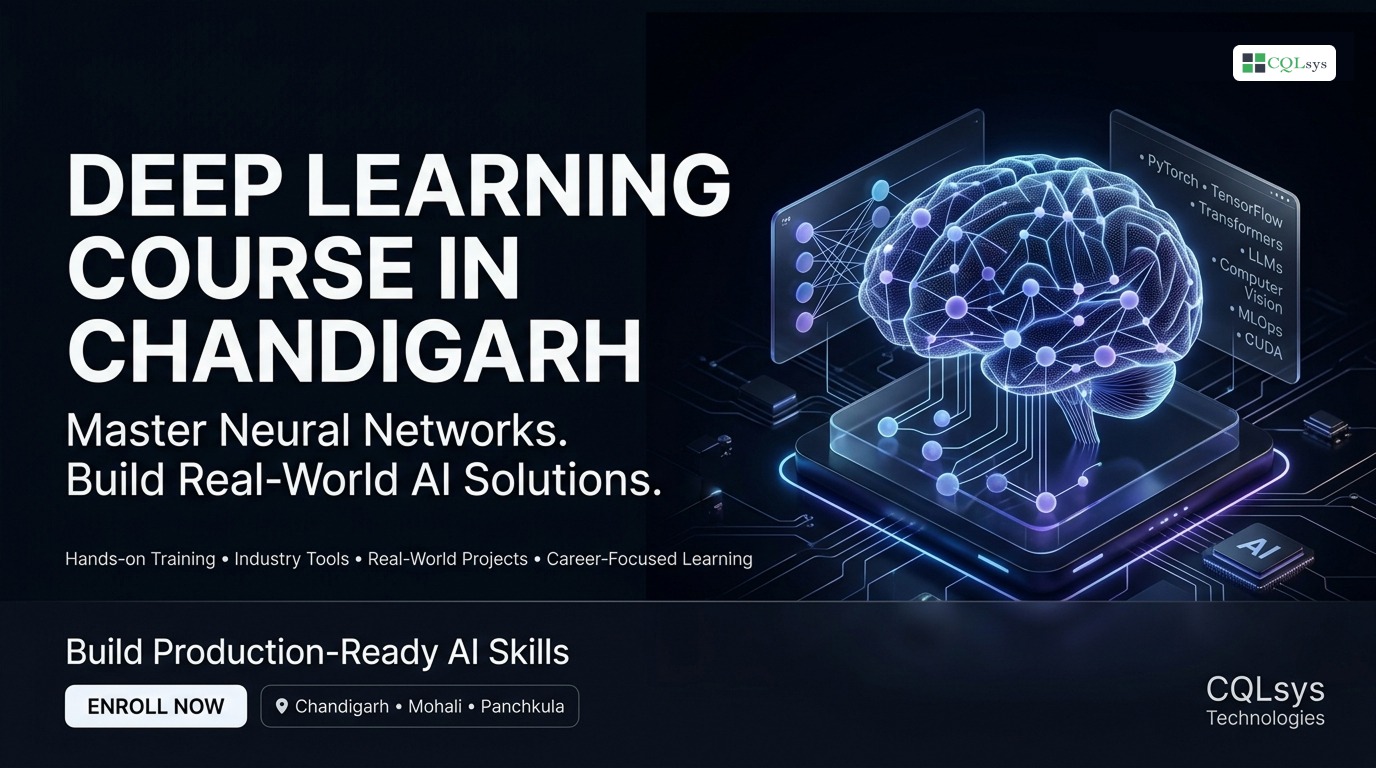
Deep Learning Course in Chandigarh: Curriculum, Projects, Tools & Career Scope
Artificial intelligence is transforming software engineering, automated decision-making, enterprise operations, and digital products. At the core of this modern technological evolution lies deep learning—a specialized subset of machine learning that utilizes multi-layered artificial neural networks to process complex, unstructured data such as text, images, video, and audio. As technology hubs expand beyond traditional metropolitan zones, Northern India, specifically the Chandigarh Capital Region (comprising Chandigarh, Mohali, and Panchkula), has emerged as a significant center for software development, IT services, and technical education.
Enrolling in a comprehensive AI course in Chandigarh provides software engineers, data analysts, and engineering students with the specialized skill set required to build, train, deploy, and scale deep neural networks. This guide breaks down the structural curriculum, software toolstack, real-world project methodologies, solution architecture, and career pathways associated with enterprise-grade deep learning training.
The Rising Demand for Deep Learning and AI Skills in Chandigarh
The technology ecosystem in Chandigarh and its neighboring IT parks has experienced steady growth, transitioning from traditional software maintenance toward high-value engineering, cloud computing, and intelligent automation. Enterprise organizations, tech startups, and global service providers are actively integrating predictive models, natural language processing, and computer vision systems into their product lineups.
Regional Ecosystem
| Sector | Operational Focus | Key Technical Demand |
|---|---|---|
| Enterprise IT Hubs | Cloud Integration & Large-Scale Systems | Neural Network Deployment, Enterprise AI Pipelines |
| AI & SaaS Startups | Automated Products & Intelligent Agents | Computer Vision, LLMs, Generative AI Integration |
| Product R&D Centers | Advanced Algorithms & Optimization | MLOps, Custom Model Training, CUDA Acceleration |
This regional evolution has created a demand for engineers who possess more than basic scripting knowledge. Companies require professionals capable of designing neural network architectures, optimizing loss functions, managing GPU acceleration, and deploying model pipelines to enterprise production environments. Completing a structured AI course in Chandigarh bridges the gap between academic theory and practical software engineering, preparing developers to meet the operational demands of modern tech firms.
Comprehensive Deep Learning Curriculum Overview
A robust deep learning curriculum is built logically, taking learners from foundational mathematical principles through artificial neural network mechanics to advanced specialized architectures like Transformers and Generative Adversarial Networks (GANs).
| Training Stage | Core Focus Areas | Key Learning Deliverables |
|---|---|---|
| Phase 1: Foundations | Mathematics, Python, Linear Algebra | Matrix operations, gradient calculus, exploratory data analysis |
| Phase 2: Core Architectures | ANNs, CNNs, RNNs, Backpropagation | Loss function optimization, computer vision filters, sequential models |
| Phase 3: Advanced AI | Transformers, Generative AI, LLMs | Multi-head attention mechanisms, pre-trained model fine-tuning |
| Phase 4: MLOps & Cloud | Model Deployment, API Gateway, Docker | Containerized inference engines, cloud server deployment |
Module 1: Foundational Mathematics and Scientific Python
Deep learning relies heavily on linear algebra, calculus, probability, and optimization techniques.
- Linear Algebra & Calculus: Vector spaces, matrix multiplication, eigenvalues, eigenvectors, gradients, and partial derivatives.
- Python Programming: Advanced Object-Oriented Programming (OOP) tailored for data manipulation using NumPy and Pandas.
- Exploratory Data Analysis (EDA): Data cleaning, feature scaling, normalization, and visual analysis using Matplotlib and Seaborn.
Module 2: Neural Network Fundamentals and Optimization
This module shifts focus to the core mechanics of artificial neural networks (ANNs).
- Perceptrons and Multilayer Perceptrons (MLPs): Architecture design, activation functions (ReLU, Sigmoid, Tanh, Softmax).
- Forward and Backpropagation: Mathematical derivation of cost functions, chain rule application, and gradient descent variants (SGD, Adam, RMSprop).
- Model Regularization: Preventing overfitting using Dropout, L1/L2 regularization, early stopping, and batch normalization.
Module 3: Computer Vision with Convolutional Neural Networks (CNNs)
Visual processing requires specialized network topologies capable of maintaining spatial hierarchies.
- Convolution Operations: Kernels, stride, padding, pooling layers, and feature map generation.
- Pre-trained Architectures: Transfer learning strategies using ResNet, VGG, Inception, and EfficientNet.
- Object Detection & Segmentation: Implementation frameworks including YOLO (You Only Look Once), R-CNN variants, and U-Net models.
Module 4: Sequence Modeling and Natural Language Processing (NLP)
Processing sequential data requires memory mechanisms within the model architecture.
- Recurrent Neural Networks (RNNs): Sequential processing, vanishing gradient challenges, and backpropagation through time.
- Advanced Gated Architectures: Long Short-Term Memory (LSTM) networks and Gated Recurrent Units (GRUs) for time-series forecasting and text analytics.
- Attention Mechanisms & Transformers: Self-attention layer mechanics, Multi-Head Attention, BERT, GPT foundation principles, and Fine-Tuning Large Language Models (LLMs).
Enterprise Tools, Libraries, and Frameworks
Professional artificial intelligence development depends on a robust ecosystem of open-source frameworks, cloud infrastructure, and hardware accelerators. Enrolling in a top-tier AI course in Chandigarh ensures hands-on exposure to standard industry toolstacks.
| Category | Primary Technologies & Tools | Operational Purpose |
|---|---|---|
| Core Frameworks | PyTorch, TensorFlow, Keras | Building, training, and evaluating deep neural networks |
| Computer Vision | OpenCV, TorchVision, Pillow | Image transformation, visual augmentations, video stream processing |
| NLP & LLMs | Hugging Face Transformers, SpaCy, NLTK | Tokenization, pre-trained language models, text vectorization |
| Hardware & Acceleration | NVIDIA CUDA, TensorRT, AWS Inferentia | High-performance matrix calculations on GPU/TPU hardware |
| MLOps & Tracking | MLflow, Docker, TensorBoard, FastAPI | Experiment logging, model containerization, REST API packaging |
Core Deep Learning Frameworks
- PyTorch: The primary framework used in industrial research and development due to its dynamic computational graph and Pythonic syntax.
- TensorFlow & Keras: Widely adopted enterprise solutions built for deployment efficiency across web, mobile, and cloud environments.
Computer Vision and NLP Libraries
- OpenCV & TorchVision: Essential tools for image transformations, video stream manipulation, and data augmentation pipelines.
- Hugging Face Transformers & SpaCy: Standard platforms for downloading pre-trained models, Tokenization, and deploying language pipelines.
Hardware Acceleration and MLOps
- NVIDIA CUDA & cuDNN: Parallel computing platforms that optimize matrix math performance directly on GPUs.
- MLflow & TensorBoard: Tools used to track experiments, monitor loss curves, log hyperparameters, and manage model versions.
- Docker & FastAPI: Standard toolset for packaging deep learning models as microservices accessible through RESTful API endpoints.
High-Level Deep Learning Solution Architecture
Deploying a deep learning model into a commercial environment requires a clean separation between data ingestion, preprocessing, training, inference, and application layers. Below is an enterprise-grade architectural framework illustrating how deep learning services integrate with real-world software applications.
| Architectural Layer | Core Components | Operational Role |
|---|---|---|
| User & Access Layer | Web App Client, Mobile App, Third-Party API | Interface through which end-users or systems trigger requests |
| Security Layer | API Gateway, OAuth2, WAF, Rate Limiter | Handles request authentication, payload validation, and traffic control |
| Application Layer | FastAPI Microservices, Celery, Redis Queue | Manages request orchestration and routes compute tasks asynchronously |
| DL Inference Engine | PyTorch, ONNX Runtime, CUDA Acceleration | Executes optimized neural network models to generate real-time predictions |
| Data & Vector Storage | Pinecone, PostgreSQL, AWS S3 Object Store | Manages relational logs, unstructured media files, and vector embeddings |
| MLOps & Monitoring | MLflow, Prometheus, Grafana, Drift Detector | Tracks model latency, hardware metrics, and accuracy degradation |
Real-World Industrial Projects Showcase
Practical application builds genuine technical confidence. Participants in an advanced AI course in Chandigarh gain direct, hands-on experience by completing real-world projects that reflect actual industry requirements.
| Project Name | Core Architecture & Tools | Business Objective & Impact |
|---|---|---|
| Visual Inspection Defect Engine | YOLOv8, OpenCV, PyTorch | Automated real-time microscopic flaw detection on manufacturing assembly lines |
| Document Intelligence System | Optical Character Recognition (OCR), Transformers | Automated extraction and structuring of data from financial invoices and legal contracts |
| Predictive Maintenance Platform | Deep LSTM Networks, Autoencoders | Real-time time-series telemetry analysis to predict industrial machinery failures |
Technical Comparison: Deep Learning Frameworks and Approaches
Choosing the right technology approach depends on project requirements, processing constraints, and target deployment platforms.
| Evaluation Metric | PyTorch | TensorFlow / Keras | Traditional Machine Learning (Scikit-Learn) |
|---|---|---|---|
| Primary Use Case | Deep learning research and custom model development | Enterprise deployment and mobile/edge inference | Structured tabular data analytics |
| Graph Type | Dynamic Computation Graph (Eager execution) | Static Graph & Eager Execution modes | Non-graph (Statistical Matrix Modeling) |
| Hardware Acceleration | Native CUDA, Apple Silicon (MPS), ROCm | Native CUDA, TPU Support, TensorRT | CPU-focused (Limited GPU capabilities) |
| Deployment Ecosystem | TorchScript, ONNX, TorchServe | TensorFlow Serving, TF Lite, TF.js | ONNX Export, Native C++ Wrappers |
| Learning Curve | Moderate (Pythonic design) | Moderate to High | Low to Moderate |
| Data Suitability | Unstructured (Images, Audio, Text) | Unstructured (Images, Audio, Text) | Tabular, Cleaned Numerical Data |
Implementation Roadmap for Deep Learning Integration
For enterprise leaders, IT decision-makers, and technical managers looking to integrate deep learning capabilities into existing software ecosystems, adopting a structured deployment process reduces risk and speeds up production readiness.
| Implementation Phase | Phase Name | Primary Actions & Deliverables |
|---|---|---|
| Phase 1 | Problem Definition | Establish business KPIs, operational constraints, latency targets, and feasibility |
| Phase 2 | Data Engineering | Aggregate, clean, annotate, and partition unstructured datasets |
| Phase 3 | Architecture Design | Select pre-trained base models, establish transfer learning pipelines, build baselines |
| Phase 4 | Training & Tuning | Execute GPU-accelerated training runs with automated hyperparameter optimization |
| Phase 5 | Evaluation & Validation | Assess precision, recall, latency, confusion matrices, and model bias |
| Phase 6 | Production MLOps | Package inference engines into Docker containers, expose APIs, configure monitoring |
Career Scope and Job Roles in the AI Ecosystem
Completing a structured AI course in Chandigarh unlocks diverse career pathways across software development, product engineering, data engineering, and enterprise AI consulting.
| Career Role | Focus Area | Primary Technical Skillset |
|---|---|---|
| Deep Learning Engineer | Neural Network Architecture & Optimization | PyTorch, TensorFlow, CUDA, Model Customization |
| Computer Vision Specialist | Visual Processing & Perception | OpenCV, YOLO, Object Detection, Image Segmentation |
| NLP / Generative AI Engineer | Natural Language Processing & Language Models | Transformers, Hugging Face, LLM Fine-Tuning, RAG |
| MLOps Engineer | Deployment Infrastructure & Pipeline Automation | Docker, Kubernetes, MLflow, CI/CD, API Gateways |
| AI Solutions Architect | Enterprise Integration & System Design | Cloud Architecture, Security, Data Lakes, Solution Design |
Why Choose CQLsys Technologies for AI and Software Development?
Building and deploying enterprise-grade artificial intelligence solutions requires technical expertise, strong software engineering foundations, and deep domain experience. CQLsys Technologies brings extensive experience across software development and custom AI development services, helping organizations convert complex technical concepts into reliable, production-ready software systems.
Whether your organization requires specialized web and mobile software development, intelligent cloud automation, or custom neural network integration, CQLsys Technologies provides technical consulting, system architecture design, and end-to-end software delivery built for scale. Explore our complete suite of software capabilities on our services page to see how we help businesses build advanced technical solutions.
Frequently Asked Questions
What is the primary difference between machine learning and deep learning?
Machine learning relies on manually engineered features to extract patterns from structured tabular data. In contrast, deep learning utilizes multi-layered artificial neural networks to automatically discover feature representations directly from complex, unstructured datasets like raw images, video streams, audio files, and natural language text.
Is prior programming experience required to enroll in a deep learning course in Chandigarh?
Yes, a foundational understanding of programming—specifically Python—along with basic mathematics, linear algebra, and statistical concepts is essential. Having prior exposure to software development principles makes it much easier to master advanced neural network frameworks like PyTorch and TensorFlow.
Which programming language is most important for deep learning engineering?
Python is the primary language used across the global deep learning ecosystem. Its clean syntax and extensive selection of scientific and machine learning libraries, including PyTorch, TensorFlow, NumPy, and Pandas, make it the industry standard for research, model training, and production deployment.
How long does it typically take to complete a comprehensive AI course in Chandigarh?
A structured, industry-focused AI course in Chandigarh generally spans 3 to 6 months. This timeline provides enough space to cover math foundations, core neural network architectures, specialized vision and NLP modules, and practical, hands-on production projects.
What hardware resources are recommended for deep learning training?
While basic theoretical models can run on multi-core CPUs, training real-world deep neural networks requires dedicated GPU hardware equipped with Tensor Cores, such as NVIDIA RTX or enterprise A100/H100 cards. Alternatively, cloud platform environments like AWS EC2, Google Cloud Vertex AI, and Google Colab offer scalable compute resources on demand.
Are hands-on projects included in deep learning training programs?
Yes, practical projects form the core of effective deep learning training programs. Students build real-world systems, such as automated defect detection tools, sentiment analysis engines, document parsers, and predictive maintenance pipelines, preparing them to handle complex software engineering challenges in industry settings.
How does deep learning integrate with Generative AI and LLMs?
Generative AI and Large Language Models (LLMs) are built directly on deep learning principles. Specifically, modern generative models use specialized deep neural network architectures like Transformers and Diffusion models to understand, process, and generate human text, code, images, and audio.
What role does MLOps play in deep learning deployment?
MLOps (Machine Learning Operations) establishes automated workflows for training, testing, packaging, deploying, and monitoring deep learning models in production. It bridges the gap between data science experimentation and ongoing software engineering operations, ensuring models remain accurate, secure, and reliable over time.
Can deep learning models be deployed on mobile and edge devices?
Yes, modern models can be optimized for edge deployment using lightweight frameworks like TensorFlow Lite, PyTorch Mobile, and ONNX Runtime. Quantization and pruning techniques reduce model size and memory requirements, enabling real-time neural network inference directly on smartphones, IoT devices, and embedded hardware.
What are the career growth opportunities after completing deep learning training?
Graduating from an advanced training program opens up technical career opportunities in roles like Deep Learning Engineer, Computer Vision Specialist, NLP Engineer, MLOps Specialist, and AI Solutions Architect across IT service companies, software product firms, and digital transformation consultancies.
Strategic Call to Action
Ready to upgrade your enterprise technology stack, integrate advanced artificial intelligence capabilities, or build custom neural network architectures tailored to your business needs?
Connect with the technical consultants and software architects at CQLsys Technologies to discuss your project requirements, schedule an engineering consultation, or plan your next digital product build.
- Visit Our Contact Page: Contact CQLsys Technologies
- Professional Networking: Connect on LinkedIn
- Social Communities: Follow on Facebook | Follow on Instagram
