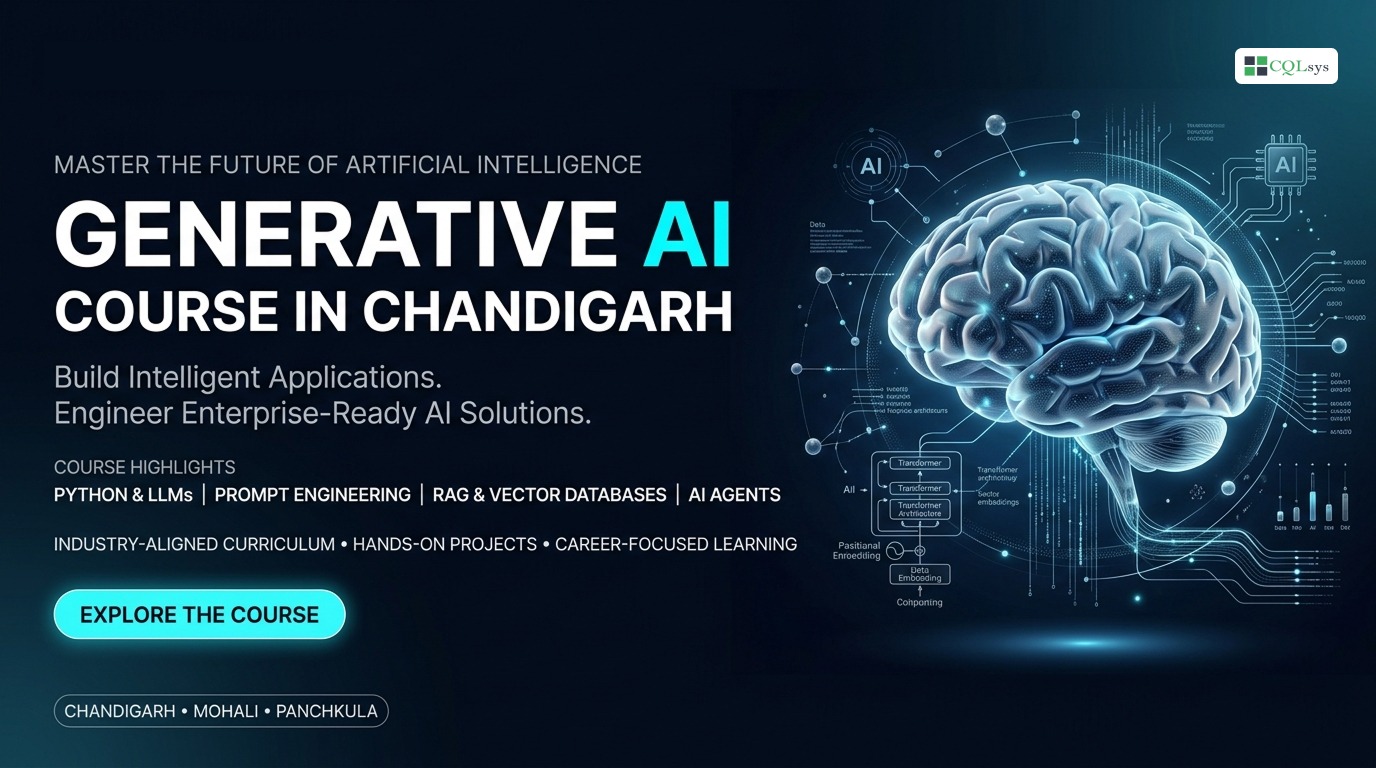
Generative AI Course in Chandigarh: Fees, Syllabus, Tools & Career Opportunities
The technology landscape is undergoing a monumental paradigm shift. Enterprise automation, natural language processing, and autonomous decision-making systems are replacing conventional software paradigms. At the center of this transformation is Generative Artificial Intelligence. Regional technology hubs, particularly Chandigarh, Panchkula, and Mohali (the Tricity region), are witnessing an unprecedented demand for skilled AI professionals who understand how to build, fine-tune, and deploy intelligent applications.
Enrolling in an advanced Generative AI Course in Chandigarh provides software engineers, data analysts, tech leaders, and ambitious students with a strategic pathway into high-value engineering roles. This comprehensive guide breaks down everything required to make an informed decision: curriculum architecture, fee expectations, technical toolstacks, enterprise application frameworks, and long-term career trajectories.
The Rising Demand for Generative AI Expertise in Chandigarh and Tricity
Chandigarh has matured from an administrative city into a prominent regional technology ecosystem. With the expansion of IT Parks, software product development firms, and technology service leaders across Mohali and Panchkula, local enterprises are actively seeking engineers capable of implementing advanced AI solutions.
Traditional software engineering competencies are no longer sufficient to maintain a competitive advantage. Global clients demand context-aware applications, automated customer intelligence, vector-driven search platforms, and autonomous multi-agent workflows. Consequently, organizations require professionals who possess formal training in Large Language Models (LLMs), deep learning architecture, and Retrieval-Augmented Generation (RAG).
Participating in specialized Generative AI training Chandigarh allows local talent to bridge the widening skill gap between legacy software engineering and modern AI system engineering. By mastering model customization, context management, and cloud-native AI deployment, practitioners place themselves at the center of regional and international hiring pipelines.
Comprehensive Syllabus Breakdown: What an Industry-Standard GenAI Course Covers
A robust AI course syllabus Chandigarh must balance foundational computer science principles with enterprise-level execution models. Theoretical understanding of machine learning algorithms must lead directly into hands-on architectural construction.
Learning Journey Progression
- Stage 1: Foundations of AI & Python Programming
- Stage 2: Neural Networks & Transformer Architectures
- Stage 3: Large Language Models & Advanced Prompt Engineering
- Stage 4: RAG Systems & Vector Database Integration
- Stage 5: Model Fine-Tuning & MLOps Infrastructure
- Stage 6: Enterprise Capstone Deployment
Module 1: Core Fundamentals of AI, Machine Learning, and Python
- Deep dive into Python for AI development, vector arithmetic with NumPy, and data manipulation using Pandas.
- Probability distributions, linear algebra, matrix operations, and gradient descent fundamentals.
- Supervised versus unsupervised learning algorithms, model evaluation metrics, and bias-variance tradeoff dynamics.
- Introduction to deep learning architectures: Multi-Layer Perceptrons (MLPs), Convolutional Neural Networks (CNNs), and Recurrent Neural Networks (RNNs).
Module 2: Transformer Architectures and Foundation Models
- Deconstructing the seminal Attention Is All You Need paper architecture.
- Self-attention mechanisms, multi-head attention calculations, positional encoding, and feed-forward networks.
- Encoder-decoder designs versus decoder-only paradigms (GPT family) and encoder-only paradigms (BERT family).
- Pre-training dynamics, tokenization methodologies (BPE, WordPiece), and vocabulary management.
Module 3: Advanced Prompt Engineering and In-Context Learning
- System prompt design, role specification, output formatting constraints, and zero-shot/few-shot prompting.
- Advanced reasoning methodologies: Chain-of-Thought (CoT), Tree-of-Thoughts (ToT), and ReAct (Reasoning + Acting) frameworks.
- Guardrails implementation, prompt injection vulnerability mitigation, and deterministic response extraction.
Module 4: Retrieval-Augmented Generation (RAG) Architecture
- Architecture of context-aware search and generation systems.
- Dense embeddings, vector space theory, and similarity search algorithms (Cosine, Euclidean, Dot Product).
- Vector Database management: Indexing strategies, metadata filtering, hybrid search algorithms (BM25 + Dense embeddings).
- Advanced RAG concepts: Query rewriting, parent-document retrieval, sentence-window retrieval, and re-ranking pipelines.
Module 5: Model Fine-Tuning, Parameter-Efficient Fine-Tuning (PEFT), and Optimization
- Supervised Fine-Tuning (SFT) vs. Reinforcement Learning from Human Feedback (RLHF) and Direct Preference Optimization (DPO).
- Parameter-Efficient Fine-Tuning mechanics: Low-Rank Adaptation (LoRA), QLoRA, and Prefix Tuning.
- Model quantization strategies (GGUF, AWQ, GPTQ) for efficient edge and cloud deployment.
Module 6: Autonomous AI Agents and Multi-Agent Orchestration
- Designing autonomous decision-making agents capable of tool utilization and external API orchestration.
- Multi-agent communication architectures, memory management models, and task-decomposition loops.
- Building stateful enterprise workflows using modern orchestration engines.
Essential Tools, Frameworks, and Libraries Included in the Curriculum
To succeed as a modern AI solutions engineer, mastering theoretical concepts is only half the battle. A practical Generative AI Course in Chandigarh provides rigorous hands-on exposure to standard industry toolstacks.
| Skill Category | Industry Tools & Frameworks Taught | Practical Application in Enterprise |
|---|---|---|
| Programming & DL Libraries | Python, PyTorch, TensorFlow, NumPy, SciPy | Building custom model layers, tensor manipulation, model training |
| LLM Orchestration | LangChain, LlamaIndex, Haystack, AutoGen | Connecting LLMs to external data, workflows, and tools |
| Vector Databases | Pinecone, Qdrant, Milvus, ChromaDB, PGVector | Storing dense vector embeddings for semantic document retrieval |
| Foundation Models & APIs | OpenAI GPT-4o, Anthropic Claude 3.5, Llama 3, Mistral | Integrating frontier commercial and open-source models |
| Fine-Tuning & Quantization | Hugging Face Transformers, PEFT, Unsloth, BitsAndBytes | Fine-tuning domain-specific base models on enterprise hardware |
| Agentic Frameworks | CrewAI, LangGraph, Semantic Kernel | Building multi-agent systems for complex business workflows |
| Evaluation & MLOps | Ragas, MLflow, LangSmith, Weights & Biases | Tracking model drift, latency, evaluation metrics, and context recall |
High-Level Solution Architecture of an Enterprise Generative AI System
Understanding how individual components interact within a corporate environment is essential for engineers. The modern enterprise AI platform must handle security, data integration, vector retrieval, model inference, and audit compliance seamlessly.
System Architecture Workflow
- Layer 1 (User Access): Web Applications, Mobile Applications, and Internal Systems.
- Layer 2 (Security & Governance): Identity & Access Management (IAM), Web Application Firewall (WAF), and Rate Limiting.
- Layer 3 (API Gateway): Request Router, Input Sanitization, and Prompt Guardrails.
- Layer 4 (AI Orchestration Engine): LangChain or LangGraph Framework managing state and application logic.
- Layer 5 (Knowledge & Model Services): Vector Database (Pinecone) for semantic context retrieval alongside Model APIs (OpenAI / Llama 3) for response generation.
- Layer 6 (Data & Analytics Storage): PostgreSQL and Data Lakes for transaction history, audit logging, and continuous evaluation.
Architectural Component Breakdown
- 1. User Experience & Access Layer: Captures user queries via responsive web interfaces, mobile platforms, or backend API hooks. It enforces rate-limiting, tenant isolation, and strict role-based access controls (RBAC).
- 2. Security & Guardrail Gateway: Scans incoming prompts for jailbreak attempts, data exfiltration patterns, and sensitive PII (Personally Identifiable Information). Ensures all operations comply with enterprise security policies.
- 3. AI Orchestration Layer: Manages application state, retrieves relevant context from external storage, routes prompts to optimal models, and aggregates responses.
- 4. Vector Knowledge Layer: Stores domain-specific knowledge as high-dimensional numerical vectors, executing sub-second similarity searches to feed relevant context into the LLM context window.
- 5. Model Inference Layer: Consists of external cloud model APIs alongside locally hosted, quantized open-source models running on dedicated GPU infrastructure.
- 6. Data Storage & Audit Layer: Logs context histories, response accuracy metrics, system latency, and usage tokens to ensure continuous monitoring and continuous learning improvements.
GenAI Course Fees, Training Duration, and Investment Analysis in Chandigarh
Understanding the fee structure and return on investment (ROI) is critical when evaluating GenAI course fees Chandigarh. Pricing typically varies based on course depth, faculty credentials, practical laboratory infrastructure, and placement support services.
| Program Level | Typical Duration | Estimated Fee Range (INR) | Key Deliverables & Features |
|---|---|---|---|
| Foundation / Short-Term | 4 to 6 Weeks | ₹15,000 – ₹25,000 | Basic Python, Prompt Engineering API integration, simple chatbot creation |
| Professional Developer | 3 to 4 Months | ₹35,000 – ₹60,000 | Deep Learning, Transformers, LangChain, RAG platforms, Vector DBs, 3 Live Projects |
| Enterprise AI Architect | 6 Months | ₹70,000 – ₹1,20,000 | Advanced Fine-Tuning (QLoRA), Multi-Agent Systems, MLOps, Custom Model Deployment |
Value Assessment & Financial ROI
An investment in professional artificial intelligence training delivers substantial career dividends. Entry-level software developers transitioning into specialized AI Engineering roles in the Tricity market typically observe significant base salary adjustments, making the initial tuition outlay highly cost-effective within the first year of deployment.
Career Pathways, Salaries, and Job Opportunities post Certification
Completing an advanced LLM developer course Chandigarh unlocks diverse technical roles across software product firms, global consulting practices, and technology outsourcing partners.
Prominent Job Roles & Target Salary Expectations
- Generative AI Engineer: Designs and builds end-to-end applications powered by foundation models, vector databases, and retrieval pipelines. Average Regional Salary: ₹8,00,000 - ₹18,00,000 PA (Experienced: ₹25,00,000+ PA).
- Prompt & Context Engineer: Specializes in optimizing interaction interfaces between enterprise logic and LLM outputs, ensuring reliable, low-latency, guardrailed execution. Average Regional Salary: ₹6,00,000 - ₹12,00,000 PA.
- AI Solutions Architect: Designs enterprise-grade, cloud-native AI infrastructures, choosing between fine-tuning vs. RAG models while ensuring security and compliance. Average Regional Salary: ₹18,00,000 - ₹35,00,000+ PA.
- NLP / Machine Learning Engineer: Focuses on training, fine-tuning, and optimizing specialized language models, tokenizers, and custom dataset pipelines. Average Regional Salary: ₹10,00,000 - ₹22,00,000 PA.
Practical Implementation Roadmap: From Student to Enterprise AI Architect
To successfully transform academic knowledge into career execution, learners should follow a structured, multi-phase technical roadmap.
Execution Phases
- Phase 1 — Mathematical & Python Foundations (Weeks 1–3): Master matrix operations, PyTorch tensor manipulation, tokenization strategies, and basic API integrations using Python.
- Phase 2 — LLM Application Orchestration & RAG (Weeks 4–8): Construct custom semantic search engines. Connect vector databases like Pinecone or Qdrant with LangChain and LlamaIndex.
- Phase 3 — Model Customization & Fine-Tuning (Weeks 9–12): Fine-tune open-source models (such as Llama 3 or Mistral) on custom domain datasets using QLoRA and Hugging Face PEFT libraries.
- Phase 4 — Agentic Workflows & Multi-Agent Systems (Weeks 13–16): Design autonomous multi-agent environments using CrewAI or LangGraph to solve real-world, multi-step business challenges.
- Phase 5 — Production Deployment & MLOps (Weeks 17–20): Containerize models, set up real-time monitoring platforms, implement evaluation benchmarks (Ragas), and manage token usage budgets.
Security, Compliance, and Responsible AI Engineering
Enterprise software adoption demands strict security parameters. A comprehensive Generative AI Course in Chandigarh prepares developers to navigate technical compliance and ethical risks effectively.
Core Security Principles for AI Engineers
- Data Privacy & Exfiltration Prevention: Ensuring enterprise data passed to language models is never utilized for public training loops or exposed across multi-tenant boundaries.
- Prompt Injection Defense: Implementing robust input sanitization layers to prevent malicious prompt injection attacks from manipulating model instructions.
- Hallucination Mitigation: Combining retrieval validation, high-precision vector search, and structured output schemas to minimize factually incorrect model responses.
- Regulatory Standards Alignment: Building systems compliant with international regulations, including the Digital Personal Data Protection (DPDP) Act in India, GDPR in Europe, and emerging global AI governance guidelines.
Real-World Enterprise Use Cases Taught in the Program
To ensure job readiness, students tackle practical enterprise challenges across key industries:
- FinTech & Banking: Developing automated financial audit bots that query thousands of compliance PDFs to highlight operational risks using hybrid RAG pipelines.
- Healthcare & Life Sciences: Building privacy-focused clinical summarization tools that assist healthcare professionals by distilling patient histories into standardized formats.
- E-Commerce & Retail: Implementing hyper-personalized customer recommendation engines and multi-modal search portals that allow buyers to discover products via text and visual queries.
- Legal & Corporate Governance: Designing automated contract review platforms that analyze complex legal agreements against corporate policy benchmarks in seconds.
Why Choose CQLsys Technologies for AI Software Development & Digital Transformation?
While education provides foundational expertise, applying AI in production requires deep software engineering capability. CQLsys Technologies stands at the forefront of digital transformation, delivering modern web, mobile, and custom AI platform solutions to global enterprises.
With deep technical domain expertise across Artificial Intelligence development, cloud computing, and full-stack software architectures, CQLsys builds high-performance, secure, and scalable digital ecosystems tailored to complex commercial goals.
Comprehensive Engineering Capabilities
- Custom AI & LLM Integration: Designing context-aware enterprise platforms, custom RAG frameworks, and autonomous agent workflows.
- Enterprise Software Development: Building reliable web and mobile applications through expert Software Development services designed for global scale.
- Modern Web Platforms: Building high-speed, secure web applications via specialized Web Development solutions.
- Cross-Platform Mobile Ecosystems: Delivering intuitive iOS and Android applications backed by high-performance cloud services via modern Mobile App Development practices.
Engineers and business leaders looking to build software systems, modernize legacy platforms, or integrate modern AI solutions can explore the complete range of capabilities by reviewing CQLsys Technologies or visiting the About Us overview.
10 SEO Frequently Asked Questions (FAQs)
1. What is covered in a Generative AI course syllabus?
A standard syllabus covers Python programming, deep learning foundations, Transformer architecture, prompt engineering, Retrieval-Augmented Generation (RAG), vector databases (Pinecone, Qdrant), fine-tuning techniques (LoRA, QLoRA), multi-agent systems, and production MLOps deployment.
2. How much does a Generative AI course cost in Chandigarh?
Course fees in Chandigarh generally range from ₹15,000 for basic short-term modules to ₹1,20,000 for advanced, multi-month enterprise developer and architect certifications that include hands-on project work and placement support.
3. What are the career prospects after completing GenAI training?
Graduates can step into high-demand roles such as Generative AI Engineer, LLM Developer, AI Solutions Architect, Prompt Engineer, and MLOps Specialist. Regional and global demand across software product firms remains consistently high.
4. Who is eligible to enroll in a Generative AI course?
Software developers, data analysts, IT professionals, system architects, and STEM graduates with basic programming knowledge (preferably Python) are ideal candidates for professional-level Generative AI training.
5. Does the Generative AI course include practical projects?
Yes, high-quality programs emphasize hands-on learning, featuring capstone projects such as building enterprise RAG platforms, fine-tuning open-source LLMs on custom datasets, and orchestrating multi-agent systems.
6. Which tools and frameworks are taught in the GenAI program?
Key tools include Python, PyTorch, LangChain, LlamaIndex, Hugging Face Transformers, OpenAI APIs, Pinecone, ChromaDB, CrewAI, LangGraph, and MLOps tracking platforms like LangSmith.
7. Is placement assistance provided with the AI course in Chandigarh?
Most reputable technology institutes across the Chandigarh, Mohali, and Panchkula regions offer resume building, technical mock interviews, portfolio creation support, and direct placement linkages with local IT firms.
8. How long does it take to complete Generative AI training?
Program durations range between 4 weeks for introductory certifications and 3 to 6 months for comprehensive software engineering programs that cover advanced model customization and enterprise system architecture.
9. Why is Chandigarh becoming a hub for AI learning?
Chandigarh and the surrounding Tricity region feature a rapidly expanding IT park infrastructure, a growing software startup ecosystem, and premier educational institutions, making it an ideal destination for technology education.
10. What is the difference between traditional AI and Generative AI courses?
Traditional AI courses emphasize predictive modeling, statistical classification, and structured data analysis. Generative AI courses focus on creating new content, natural language understanding, foundation model customization, transformer designs, and autonomous decision-making agents.
Are you ready to accelerate your digital transformation strategy or integrate custom Generative AI solutions into your enterprise workflow? Whether you need custom software architecture, enterprise AI development, or scalable cloud platforms, the expert engineering team at CQLsys Technologies is ready to assist.
Explore our latest insights on the official CQLsys Blog or connect directly with our technology consultants to discuss your custom project requirements.
Schedule an Enterprise AI & Software Consultation: Contact Us
Follow our latest technology updates across our professional networks:
